“Food desert” and “food insecurity” are terms understood and used frequently in the world of nonprofits. Food desert refers to an area that has limited access to fresh and healthy food. Food deserts can exist in rural or urban areas. They typically lack a grocery store but may offer fast food or convenience store food items that are less healthy than fresh food. Food insecurity refers to inconsistent access to fresh and healthy food for various reasons, often financial.
It is ironic, a county as rich in agricultural resources as Oceana County is also home to many families with food insecurity. Executive Director for the Lakeshore Food Club O’Nealya Gronstal has seen the number of households served by the Lakeshore Food Club increase from 400 in 2020 to 2,800 households in 2025. In 2017, the Lakeshore Food Club, 920 E. Tinkham Ave. in Ludington, served only the Ludington area. In 2023, they expanded with a Food Club at the Gateway to Success Academy and this school year they opened a Food Club at the Mason County Central School.
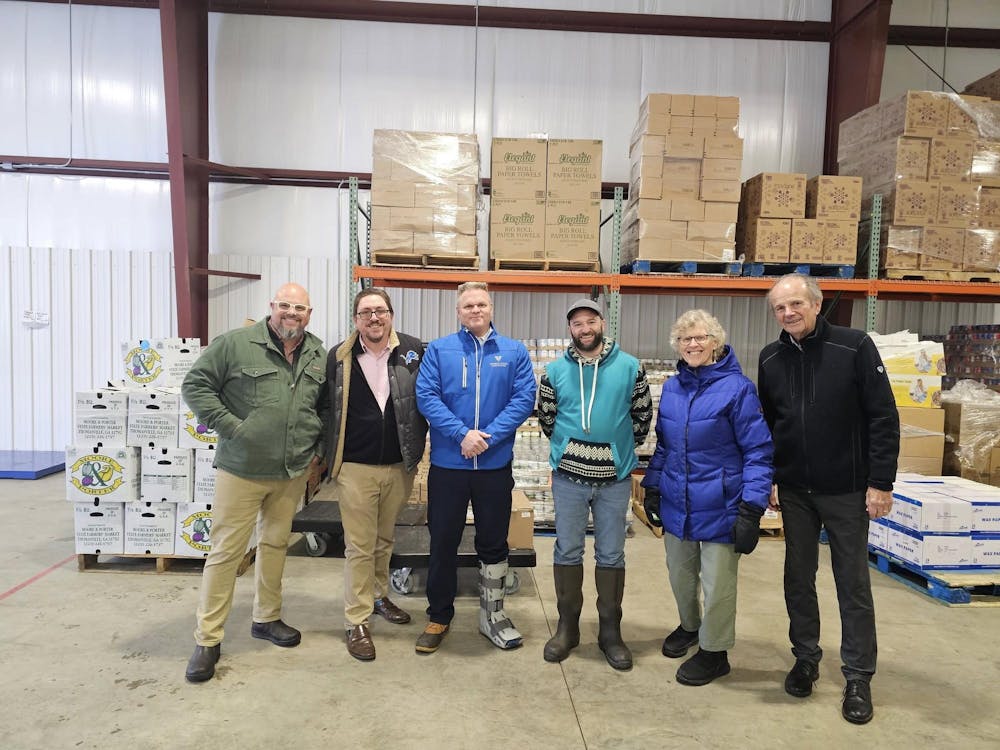
Last fall they purchased a warehouse at 1525 Industrial Park Dr. in Hart to serve as the Lakeshore Food Club Regional Food Hub. The facility has enabled them to collect and distribute food to pantries in five counties. Gronstal reported, “I anticipate our membership to grow by an additional 1,500 or more households when our Food Club opens in Hart late this fall.”
Lakeshore Food Club is investing to expand its service in Oceana County at a time when food assistance programs are facing possible cutbacks in funding. The Oceana County expansion will eventually have a Food Club in the former IGA building in Hart that is being remodeled for community use by West Shore Community College. Already the Food Club is busy at the 6,000-square-foot regional warehouse hub in Hart. Staff and volunteers have handled approximately 100,000 pounds of food since Dec. 1. They have unloaded the food that has been donated, weighed the food, and sorted and repacked the items for distribution to other locations.
“There are many misconceptions about people who seek food assistance. Our members are not primarily people who are unemployed. The majority, by far, are working people whose income has not kept up with the cost of living. They include teachers, hairdressers and food servers with families to feed, clothe and house and who can’t keep up with expenses. They also include retired seniors on fixed incomes who can no longer afford what they could purchase a few years ago,” Gronstal explained
Lakeshore Food Club is unique in several ways. While most food pantries are open for limited hours only a few days a month, the Food Club hours are flexible. While they are open during normal business hours Monday through Saturday, they may open early one day and remain open late a couple of days to enable workers to stop and shop outside of work hours. Hours are determined by the needs of the community. Food is “purchased” with points rather than cash, and members are given points each month determined by their income and household size. “The genius of the system,” Gronstal enthuses, “is that the healthier the food is, the fewer the points are to ‘buy’ it. So we are creating greater access to healthy food.”
That principle was evident at the Food Club at the Gateway to Success (G2S) school in Scottville. (See the Jan. 2, 2026 edition of the Oceana Echo)
Food Club membership is available to qualifying individuals and households for a monthly $12 fee. Qualification is based on self-reported income and household size. No documented proof is required. Household income up to 200% of the federally defined poverty level qualifies for membership. That dollar amount differs with household size.
Gronstal said, “The Food Club fills a very large gap. The federal SNAP food program serves households only up to 185% of the poverty level. There are so many families with food insecurity between the 185% level the federal government serves and the 200% level we serve. The government definition may change from one year to the next. Prospective members can find income guidelines posted at every Food Club location, and they are discussed at membership registration.”
How far does the monthly allotment of points go? “Most families can get sufficient food for 2 1/2 to 3 weeks before their points are used up. The points range from 60 for an individual to 150 for a family of five or more.”
Food Club product sources are diverse. Gronstal recited the list: “Sam’s Club, Meijer and Costco and other grocery stores donate food. We receive food through Feeding America to redistribute to food pantries in five counties: Lake, Mason, Muskegon, Oceana and Newaygo.
“From May through October we buy food from local farms. The state provides funds for MASS, the Michigan Agricultural Surplus Systems. We recently used MASS funds to purchase a large quantity of apples from a farmer in Coopersville and to transport them to our hub. There we sorted and packaged them for distribution.”
She also shared, “Food purchase and transportation costs are our biggest financial burden - picking up and delivering donations to our hub, and then redistributing them to our Food Clubs and pantry partners. We depend on local donations and grants for financial support to our program.”
Do local stores feel threatened by the “competition” of the Food Club? “No. They see we are not competing with them, but supplementing food for families who cannot afford to buy all their groceries at most local stores. Grocers are concerned about food insecurity in their community and support our mission.”
Food insecurity is frequently part of a constellation of challenges: housing, medical costs, car costs and the list goes on. That is the reason the Lakeshore Food Club partners with other community service organizations. Stay tuned for more news on those partnerships in a future issue of the Echo.
Currently there is a need for more volunteers at the warehouse hub in Hart as shipments arrive throughout the week. Gronstal said volunteer shifts are only two hours long.
The goal is to prepare the food for shipment to pantry partners. When the Hart Food Club opens, volunteers will be needed for stocking shelves and cashiering. A brief orientation is required to provide volunteers with food safety handling instructions and additional information to help in various roles. To register as a volunteer, go to aglossinger@lakeshorefoodclub.org or fill out a form on the website, www.lakeshorefoodclub.org/volu...