I think the most fitting introduction to Camp Houk is through the manner in which I was introduced 11 years ago. The setting - May 2015. You are a junior at Hart High School. Your main concerns are your ACT scores (decent), whether the new drugstore lipstick you bought matches your complexion (it does not) and how mean your parents are for not allowing you to go to the movies for the third time that week ("Avengers: Age of Ultron" was in theaters).
Your most pertinent concern, however, is how many more marching band performances you’d have to slog through before senior year. You thought all that remained was Memorial Day and the Asparagus Parade, but you were mistaken.
It's the first beautiful day of the year. In fact, you could probably consider it summer by now. Everything was a bright green, the air smelled fresh, and the sky was mostly blue with a few fluffy clouds for shade here and there. It’s the first beautiful day of the year, and you are crammed into a school bus with the rest of the Hart High School Marching Band, back then still directed by John Taranko, headed out to Elbridge Township (no cell service, don’t even think about it). The gig is for some Civil War thing celebrating some anniversary (it was the 150th anniversary of the war’s ending).
As your bus is rumbling down some dirt roads and a logging trail, you and the rest of the band are trying to figure out what in God’s name this event is and what in Michigan is significant to the Civil War - that’s, like, a Pennsylvania thing. Mr. T undoubtedly told you all, but you were too busy Snapchatting in class. You have all decided that it was a Civil War training ground for the, like, 200 Michiganders who fought in the war (it was closer to 90,000).
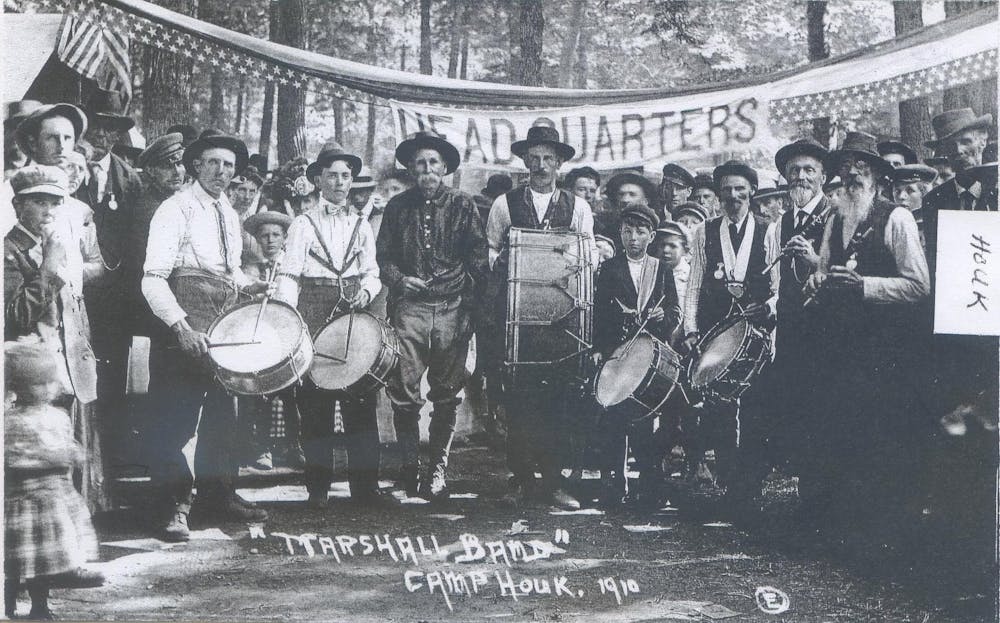
Camp Houk was not that. It was a reunion ground for Civil War veterans, an annual event that, in the summer at the turn of the century, drew in a greater crowd than the county fair. Once upon a time, it was a big deal. But now it's an overgrown clearing in the woods, only for today made presentable with tents, lawnchairs and a stage where a handful of speakers are waiting to present. One of them is dressed like Abe Lincoln.
The band plays "The Star-Spangled Banner" and a couple of military themes. You think you’re done, but then you are informed that you have to play "Taps" at the end of the ceremony. And by “you have to play 'Taps,'” they mean “two trumpeters have to play 'Taps,' and no, we aren’t just going to leave them here - stop asking.”
You spend the next hour (or what felt like an hour) sweating in your polyester uniform, standing in formation and listening to the speakers go on and on, and this place wasn’t built for acoustics, so you’re only capturing every other word. At one point, a saxophone player faints dead away, landing face-down on her instrument (she and the instrument were unharmed), and the speakers are unfazed. Finally, the band kids are given some water (if only you knew a freshwater spring was bubbling a handful of yards away).
You look up at the stage and recognize one man (well, you recognize two, but you don’t know Abe Lincoln personally) as Mr. Walt Urick - you cat-sit for him and his wife, Karen. The dulcet tones of the speakers, the warm sun, and his blanket-esque judge’s robes have put him right to sleep (he’d call it “meditating”), and you couldn't envy anyone more.
Just about the time you start wondering, "Why is this worthwhile? Who cares?” is when you hear a murmur spread throughout the band. “Guys, they’re gonna fire off a cannon!” You’re all shepherded to the edge of the forest, where a couple of reenactors have set up an unassuming black cylinder that, you guess, must be the cannon. Because you want to look cool, you don’t cover your ears - you should have.
The most tremendous sound you ever heard nearly splits your eardrums in two. The ground shook, the trees seemed to bend ever so slightly, and for a moment it felt like even your bones were vibrating. It was so loud that your parents, who were dozens of miles away in Pentwater, heard the cannon. It spooks an owl from its hollow and chases it to a branch just above your heads. In the wake of the loudest sound you’ve ever heard, "Taps" begins to play, with the owl echoing their tune. Now, you’re allowed to go home.
On the bus ride back, you think how on earth any soldier could have tolerated the sound of cannons, multiple cannons, just like that for days on end. For a minute, you put yourself in their shoes. It’s a habit you’ll continue for the next decade, taking a minute to sit and consider the humans that came before you, what they fought for, what they built and what they had for breakfast.
Coincidentally, you start seriously considering history programs for college.
It only took me a decade to learn about the story of Camp Houk, and I hope you’ll join me for the next couple weeks as I share its history, its importance in Oceana County and what the future holds for that clearing in the woods.