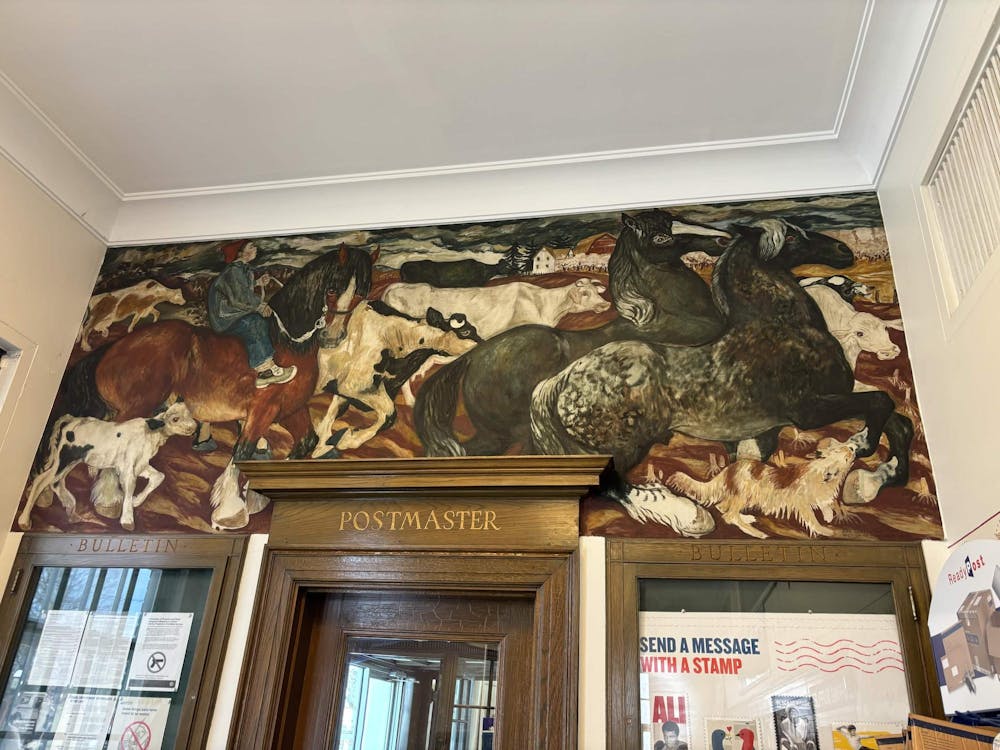
I am always excited to receive feedback from the 1306’s readership, mostly because without community suggestions, you’re all subjected to whatever four-week historical subject on which I’m fixated. So when a reader asked in our recent survey if the column could feature more articles on historic buildings in Oceana County, immediately several ideas came to mind. One idea that came to mind is Hart’s post office on State Street, which is perhaps my favorite building in the county.
I can likely credit my love of this building to some sort of architecturally-informed Stockholm Syndrome due to the numerous times I felt trapped in that building while running errands with my mother, especially while under the age of 10. While I’ve since been informed that mom’s daily visits to the post office to drop off packages of biopsy samples to MSU’s veterinary science labs were not, indeed, 45 minutes long, as I perceived them to be - something can be said for the observations of a bored 2nd grader.
I always loved how echoey the space was, both so narrow and vast, with a warm glow and a comforting scent. 20 years, two art degrees and one architectural historian best friend later, I can identify the features of the building that prompt those sensations. The building, though only one-story, is tall, with vented transom windows placed on the wall between the lobby and workspace. While acoustically entertaining for a kid singing Disney songs to herself, they serve a greater purpose of providing air circulation and cooling in a busy office. The warm glow owes itself to both my nostalgia and the amount of carved wooden features, particularly the entrance vestibule, counters, mail slots and doors. With a keener eye, I have recently been able to notice the incised features, little details that take up significant time in the manufacturing process, but make a world of difference in aesthetics.
I have nothing to say about the smell. I’m just one of those unique individuals who enjoys sniffing old paper.
But undoubtedly, my favorite part of the Hart Post Office - and I’m positive I’m not alone in this - is the mural located in the lobby, right above the door leading to the postmaster’s office. The mural features a young boy on horseback driving a herd of cattle and two other horses amongst Midwestern farmland.
The painting is signed “Ruth Grotenrath - Section of Fine Arts 1940,” and is our first clue as to the origin story of the building. This mural, though completed in 1940, is an example of a mural completed with the funding of the federal Treasury Department of Fine Arts, part of President Franklin Roosevelt’s New Deal and Works Progress Administration. Simply put during the Great Depression, the federal government was directed to create projects ranging anywhere from road construction to building design to mural painting, all to provide millions of unemployed Americans a steady paycheck as the economy hit rock-bottom.
These New Deal programs also included the construction of hundreds of post office buildings nationwide, many with murals inside. Mural paintings were popularized throughout the 1930s by artists such as Diego Rivera, with bold shapes, colors and stylization, with subject matter that often focused on everyday working-class citizens. This painting by Grotenrath in particular is an example of American Regionalism, a subsection of the American realist modernism movement. For a particularly famous example, think American Gothic by Grant Wood. This subsect in particular was quite popular in the Midwest, with a focus on rural life, pastoral countryside and elements of European abstractism without losing the quintessential American realism.
As for the building, much of the pertinent information can be found on the cornerstone on the outside facade - you just have to lean over and around the end of the ramp and make a general nuisance of yourself to everyone else picking up packages. The cornerstone declares the building's completion as 1939, with Louis A Simon as the supervising architect and Neal A Lemick as supervising engineer. To further date the building dedication are also the names of the Postmaster General of the time, James A Farely, and Secretary of the Treasury Henry Morgenthau Jr. As it turns out, most of the post offices built in the U.S. through WPA funds were designed by Simon.
The building itself is less Art Deco than one might expect from a building designed and constructed in the 1930s. In fact, the plain, symmetrical facade of limestone and red brick is far more reminiscent of neoclassical and federalist architecture. Particularly the doorframe, with architectural features reminiscent of Classical Greek and Roman columns. Clearly we can see the reason why a federal building funded to keep working-class people afloat and promote a concept of American perseverance would evoke the same architecture so emblematic of our nation’s capital and its earliest years of infancy.
Some additions have been made over the years (particularly that ramp, while I maintain that accessibility is far more important than an unobstructed cornerstone), but much of the building remains as it was when first constructed almost a century ago, conjuring the same subtle insistence of federal austerity as was intended. And for fans of Grotenrath’s mural, if you desire to see a smaller and less refined study of the same painting, you can travel all the way to Washington D.C., where the Smithsonian American Art Museum keeps it in their archives. Or you can just drive downtown to pick up your Amazon package to appreciate the finished piece.