I was recently out to dinner with a young man who said to me, “I get the vibe that you like taking walks in cemeteries.” Out of all the assumptions made about me on first dates, that has to be the strangest and most accurate. It reminded me that I haven’t visited a cemetery in a while, so in celebration of October beginning this week, I took a trip to Pentwater Township Cemetery.
This cemetery was first established in 1860, but not in the location where it now sits. Following the death of his young son Willie, Jacob Brillhart established a block of land outside of Pentwater’s then-village limits to use as a burial ground for his son. By 1870, multiple Pentwater families had buried their relatives on this plot, now the site of Pentwater’s First Baptist Church. By this time, Pentwater’s village limits had expanded beyond the cemetery, leading to the acquisition of 40 acres farther outside of the city to use for a new cemetery. By September 1879, 99 remains and their headstones were relocated from the original plot to the new cemetery, located north of the village along old US Route 31. The new cemetery saw expansion in 1992 and 2012, and, while much of the original 40 acres has been parceled off and sold, the current cemetery is spread across 20 acres of land.
When comparing Pentwater Township Cemetery with my trip to Mouth Cemetery in early August, I identified some stark differences. For starters, Mouth Cemetery is only 3 acres, making it relatively easy to walk up and down the haphazard rows of headstones. Pentwater Township, on the other hand, is over six times the size. While both cemeteries are set on high ground, overlooking water, Mouth Cemetery has little change in elevation. Pentwater Township’s plots are spread over multiple terraced hills. Finally, Mouth Cemetery, while it has several newer gravesites, is primarily filled with historic plots, which limits the number of new interments it can take. Pentwater Township is an active cemetery, which, likewise, receives a lot more care and upkeep.
Also, I didn’t get lost searching for Pentwater Township Cemetery, which is always preferred.
Because Pentwater Township Cemetery has an abundance of graves - and by extension grave markers - I was quite excited by the prospect of exploring the grounds. In an architectural history class, a professor shared with us that cemeteries hold a wealth of examples of “fad” architecture trends. Some examples he gave us were grave markers with Gothic-revival spires from the mid-19th century or pyramid-shaped mausoleums inspired by the Egyptomania trends of the 1920s. Since then, I’ve always had an eye out for interesting grave marker trends that present themselves in cemeteries across the U.S. and Europe.
Pentwater Township Cemetery was no exception. What surprised me when comparing Pentwater and Mouth was the former’s sheer number of obelisk-style grave markers. The popularity in the 19th century of obelisk grave markers began, in part, with an earlier Egyptomania craze following Napoleon’s military campaign in Egypt and the discovery of the Rosetta Stone in 1801. It persisted throughout the century with the British occupation of Egypt, beginning in 1883. Across the many colonial powers that have occupied Egypt, obelisks were a common architectural feature to loot due to their relative ease of transportation and iconic design. (History joke: Why are the Pyramids of Giza in Cairo? Because they were too big for the British Museum to take to London!)
Of course, the obelisks we see in cemeteries are not stolen artifacts, but rather an homage to an ancient civilization that captured the cultural zeitgeist of Europe and the Americas for over a century.
Obelisks make up a large majority of 19th-century grave markers in Pentwater Township Cemetery, but they are not the oldest designs. The oldest grave markers, many of which would have been moved from the first site in Pentwater Village, are the thin, simple slabs with rounded tops. Something notable about many of these traditional slabs in Pentwater is that several have broken over the years and have been subsequently reinforced by casting the pieces in a cement slab. The result looks a little off-kilter, I hate to admit, but it's a quick and cheap fix that preserves the original marker.
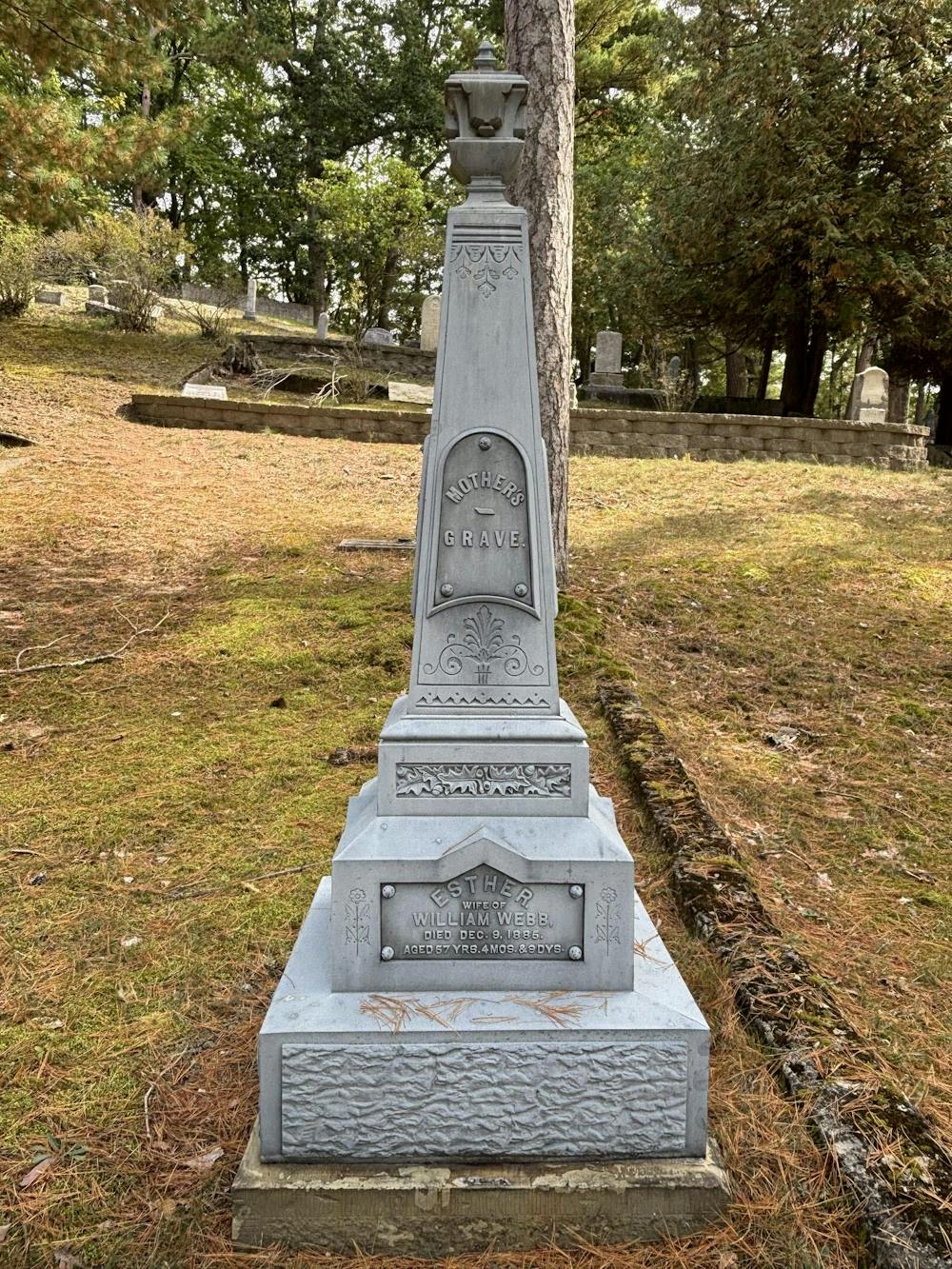
There were also several examples of what are called “white bronze” gravestones. The name is a bit misleading, as the markers are actually more of a bluish-grey and are made of zinc, not bronze. What’s striking about this trend of grave markers is that they are amazingly resilient to weathering. Despite the fact that these markers are almost 150 years old, they look as if they were carved just yesterday. Again, it’s misleading, as these markers are not carved, but in fact made from cast molds. Despite their elaborate designs, these markers were surprisingly cheap to make. However, like most mass-produced items, the trend did not end up lasting as long as obelisks.
As I ventured further into the newer, northern wing of the cemetery, the pine trees began to thin out, the terrain leveled, and grass lawns overtook needle and moss carpets. To my surprise, many of the granite headstones in this area were streaked in what looked like rust. Obviously, stone can’t rust, and I didn’t immediately have an answer for why the markers looked like this. Upon further research, other instances of this odd reaction were attributed to residue from water. Since these crops of markers spread over the sunny cemetery lawns were exposed to the elements and, presumably, to water sprinklers, this might be the reason for the discoloration.
I don’t know how many more pleasant days we’ll have this autumn, so I encourage readers to take a quiet, contemplative walk in a cemetery. I promise, it's not as spooky as you think.