Today’s postcard comes to us from just outside of Walkerville, specifically a little spot called Peachville, which used to be a stop along the Mason and Oceana counties’ logging railroad. The Peachville Stop served a logging camp about 5 miles north of Walkerville, which served as the terminus station of the line for many years before the track was extended further south to Maple Ridge, near Hesperia.
The Butters family of Mason County sponsored and built this railroad in 1875 to take advantage of the wealth of old-growth lumber throughout this area between the two counties, which had remained untouched due to the lack of waterways to service a large-scale logging operation. This method of transportation allowed tons of lumber to be transported from any camp along the route, from the far east reaches of Oceana County all the way to the sawmill at Buttersville on Pere Marquette Lake.
Though primarily used for lumber transport, by 1886 passenger cars for lumber workers and their families also serviced the line. With the new industry in the area, communities like Crystal Valley and Walkerville (previously named Stetson) quickly grew in population, as did the smaller stops along the line - Riverton, Wiley, Fern, Peachville, Lake, Goodrich and Maple Ridge.
By 1906, however, lumber resources were already drying up in the area, leaving several stops abandoned. By 1908, the Butters Lumber Company had sold the line to the Grand Rapids & Northwestern Railroad Company, with plans to incorporate and extend the line into the existing web of railways throughout Western Michigan. Sadly, the following year a fire destroyed many buildings in Buttersville, and operations on the line quickly began to drop off. By 1912, the line had been abandoned and scrapped for parts, leaving nothing more than a long scar through miles of wilderness stripped bare for lumber.
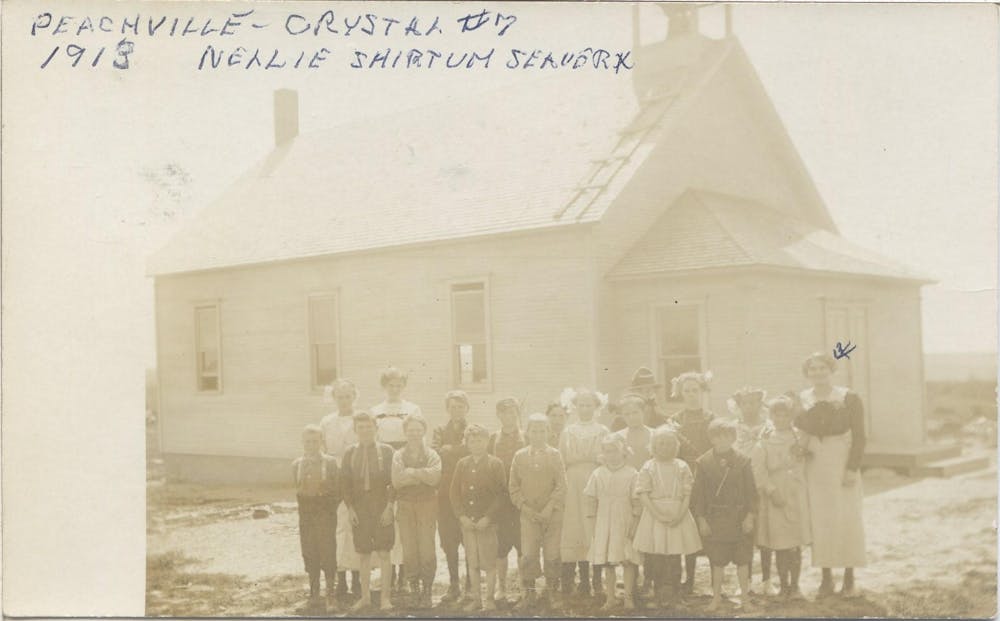
In 1913, today’s postcard example was sent. The photograph, washed out and sun-faded, shows a standard one-room schoolhouse in Peachville. The class of 19 students poses in front of the schoolhouse, with their teacher placed at the far right. As to be expected, the class is a mix of ages and grades, with an almost even split of nine girls and 10 boys. Compared to other class photos we’ve seen from other communities in Oceana County, many children in the Peachville schoolhouse class were certainly less well-off. The girls’ dresses denote a mix of decades, hand-me-downs altered to fit the child, and current fashions as best they could. Many of the children are barefoot. Despite this, some accessorizing is done in order to “dress up” the children as best as possible. I’m specifically looking at the large hair bows on the girls and a combination of vests and neckties on the boys.
Postmarked May 28 in Walkerville, the card was sent to a Mrs. Ada Shirtum of Montague, Michigan, and reads as follows:
“Dear Mother: Here we come (only 10 are lacking) What are you folks doing this nice weather? Have you the silo yet? I had 2 new pupils yesterday. Just think only two more weeks after this. I will not try and come the 29. You come in June if you can. Went + saw Grace Sat. had a fine time. Nellie.”
Thankfully, someone had already identified Nellie Shirtum Seaver as the schoolteacher in the front photo, with a helpful little arrow and note written in pen. Nellie was born in Claybanks Township in 1894 and graduated from County Normal School. The recipient of her card, mother Ada Kimball Shirtum, was born in Buffalo, New York in 1858. She married German immigrant Peter John Shirtum (or Shetrum) in 1881 in Montague, before establishing a farm in Claybanks. Ada passed away in 1935, and Peter preceded her in death 28 years earlier in 1907. The nature of his death was sudden, following “overexertion” on a trip out to New York to visit family, and his obituary highlights the distress felt by his wife and children. Nellie would have been 13 at the time of her father’s death.
Following Nellie’s graduation, she taught at a variety of schools in the county, including Flower Creek and Pine Grove as well as Peachville. She married Eveard Seaver (another son of German immigrants farming in Montague) in 1916. Nellie and Eveard had one son, Roger, whose collection the postcard came from. Besides teaching, she helped run Eveard’s general store in Rothbury and farm in Claybanks. She passed away in 1990, at the stunning age of 96.
This postcard is just a mere snapshot of her long teaching career, for which she is often mentioned in personal accounts. She would have been 19 in 1913, and likely Peachville was one of the first places she taught. While her brief note to her mother mostly focuses on Ada, the farm and her next visit - Nellie does take some time to mention her students, likely with some pride if she took the effort to send the postcard with their class portrait. I wonder if during their visits Nellie would tell stories about her students, and so perhaps the postcard was to provide some visual aid to her mother. Such as, “Oh yes, Johnny is an absolute menace; he’s the one in the front row, second from the left.”
While it doesn’t feel like it now, back in 1913 - especially with no train line remaining - going from Montague to Walkerville would have been quite the trek. Who knows the last time Nellie saw her mother before sending this postcard? I wonder if she got homesick, especially considering she was the youngest child and perhaps the last to leave home. I hope they were able to reunite in June.