First let’s set the scene - it's the mid-19th-century England. Charles Dickens writes "A Christmas Carol" and it becomes an instant classic, introducing an altruistic sensibility to and romanticizing a holiday that is enjoyed, but not yet the beloved spectacle of the western world. Queen Victoria introduces a Germanic tradition to England, and pretty soon the image of her family decorating an indoor evergreen tree becomes an idyllic embodiment of the holiday.
The onset of the Industrial Revolution likewise allows a great amount of cheap goods to circulate the market, affordable for the rising middle class. Advancements in the UK’s Royal Mail introduce prepaid stamps, providing cheap and efficient mailing across the nation. Printing presses open left, right and center, producing not only written works, but also illustrations following the introduction of inexpensive lithography.
Those ingredients come together to create the spirit of Christmas we know today: philanthropy, cheer and goodwill spread amongst the family. Gifts and cards can be sent far and wide, fast and cheap, leading to a part of the holiday hinged on the custom of giving and receiving material goods.
The first Christmas cards come to us from Victorian England, featuring a jolly-looking family celebrating their holiday libations, framed by vignettes of people aiding those less fortunate. Below, a printed greeting: “A Merry Christmas And A Happy New Year To You.” From there, a template is born.
With hundreds of illustrators and printers flooding the market with paper goods, they all brought a variety of strange iconography. Such is the same in the United States, a burgeoning nation of immigrants all with their own cultural traditions. Basically, we hadn’t yet come up with a visual language to describe the holiday, and printers were throwing everything at the wall to see what would stick. This is where those bizarre cards emerge with dead robins, ice-skating frogs and a staggering amount of anthropomorphized vegetables.
By the start of the next century, we managed to find a good stock of Christmas iconography - the angels, stars, holly, choo-choo trains and sleighs - and by 1915, the Hall brothers of Kansas City opened their greeting card company, creating a standard size and layout and thousands of designs for patrons to choose from. Now I hear the company also makes Christmas movies.
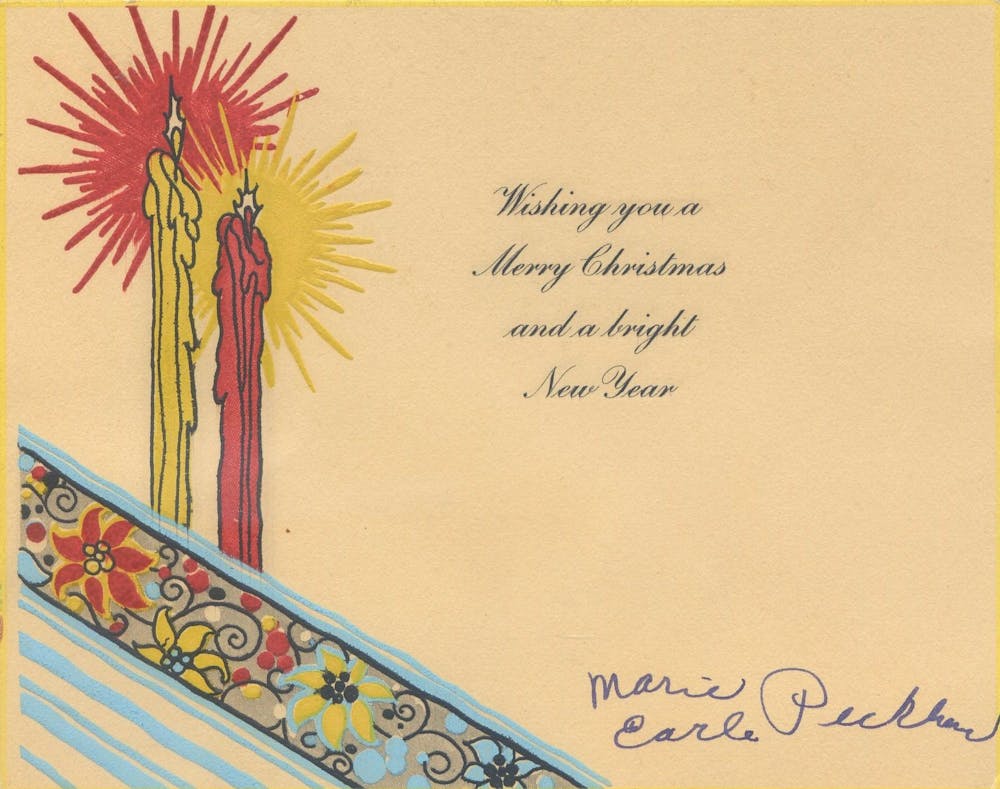
I took a trip through the Oceana County Historical & Genealogical Society’s archival box of vintage Christmas cards and pulled a handful that I found particularly noteworthy - either for their aesthetics or unique qualities. Some showcase my favorite qualities of vintage cards: minimalist styles with limited color palettes and simple shapes (bonus points for some gold or silver foil). Another popular motif of mid-century Christmas cards, one that still makes some appearances today, is bucolic little winter scenes set in the Victorian age, harkening back to that Dickensian nostalgia that first popularized the holiday. Another popular brand of card was those made for and sent by foreign service members. I'm quite charmed by the little illustration of a G.I. and all the Parisian locales he’s visited. Finally, perhaps the most fascinating one I found in the collection was a Christmas card complete with a 45 rpm record of the sender's rendition of Silent Night.