I don’t know about you all, but when I’m snowed in and chilly, I like to watch movies set in picturesque, balmy locales and scroll through my camera roll of more tropical vacations. If I were willing to brave the icy roads and stroll through an antique mall, I’d be browsing through postcards from the Caribbean or Pacific Islands or anything with even half a palm tree.
Unfortunately for my piña colada dreams, the Historical & Genealogical Society’s postcard collection only includes pictures of Oceana County. However, what they lack in cabanas they make up for in historic photos of snowbanks as deep as the Grand Canyon.
I think it’s fair to say that most born and bred Michiganders have lived through at least one snowstorm where they can stare into the middle distance as they recollect miles of unending snow. I for one remember how we got a whole extra week off of school following winter break in 2014. With little prompting, my dad will spin a yarn about the infamous “Blizzard of 1978” and the month he had off of school.
If you typed “Michigan snowstorm” in Google, the autocomplete function would populate a variety of years notable for significant blizzards: 1967, 1978, 2014, 2019 and (most ominously) “Michigan snowstorm coming.”
While perusing the OCH&GS's postcard collection, I found multiple postcards documenting two storms: 1936 and 1918.
The one from 1918 has a photograph that shows the Pere Marquette train traversing through a field of snow, the bank so deep it covers the wheels and lower fourth of the caboose. Looking closer, you’ll notice four engines. Four engines, four coal cars, and one caboose. I’m no train expert myself, but those more locomotively minded than I will note that having multiple engines on a train increases its speed and pulling power. I’d venture a guess that the caboose pictured is not nearly heavy enough to warrant the extra horsepower, but rather the multiple engines paint a picture of how much power was needed to just get the train moving down the track through the ice and snow.
The caption below the photo reads “Worst Snow Storm in Years on P.M.R.R. - Hart - MICH. Jan 15, 1918” along with a photo credit to R.M. Bedell.
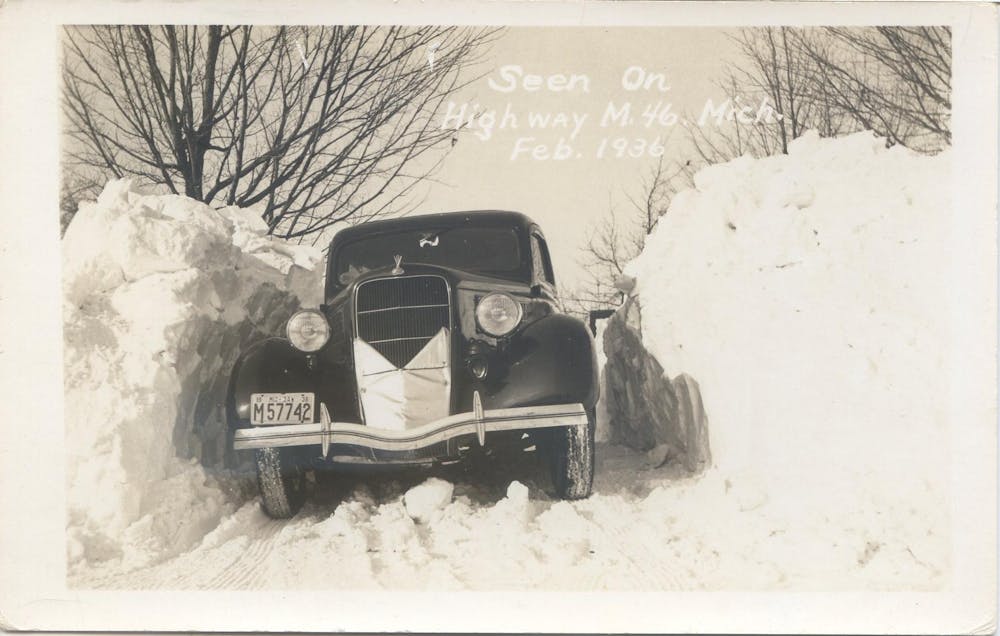
Another postcard also utilizes a mode of transportation to convey scale, with the automobile positively dwarfed by the snowbanks crowding either side. Honestly, I am struggling to tell how anyone could get in or out of it with how little leeway is given. I imagine you could easily hop from the crest of one snowbank onto the top of the car and make it to the opposite snowbank with little trouble.
The photo’s caption reads, “Seen on Highway M.46, Mich. Feb. 1936.
February 1936 saw a tremendous snowstorm hit the Midwest, with a northwest gale bringing in 45 mph winds and record low temperatures. In fact, that February is the coldest average on record for the entire contiguous United States. For six consecutive weeks in Western Michigan, the daily highs did not even reach above zero degrees Fahrenheit. Of course, none of this was helped by the lake effect snow, which dumped snow as deep as 10 feet in some places. And of course, the summer of that same year saw the worst heat wave in North America in the 20th century.
And to answer the most important question regarding the 1936 photograph - no, I don’t know what model of car that is. I’ll take a stab in the dark and say it's a 1930-something Ford V8, and I do expect someone to hunt me down to correct me.
Neither of these postcards had been written on, let alone sent through the mail, and while I did find plenty of postcards in the collection with winter scenes that had messages, most of them were postmarked in summer and bragged about all the swimming and fishing the senders were getting up to while on vacation. Lucky ducks.