First, allow me to briefly brag. New Orleans is so beautiful! New Orleans is so colorful! My past week has been spent in the tropical sun with consistent 70-degree weather and refreshing breezes, enjoying iced beverages and Southern cuisine. I even have a sunburn.
However, my trip hasn’t been all cocktails and King Cakes and getting pelted in the face with Mardi Gras beads - I have also sampled some of the wonderful offerings of historic cultural institutions.
Within my first 24 hours in the city, I’d visited the French Quarter and the Historic New Orleans Collection, which showcased a variety of exhibits from bayou ecosystems to the Civil Rights Movement. I also toured Preservation Hall, the famous jazz venue, and the Sazerac House. All three visits were free, and the Sazerac House even offers complimentary cocktail samplings on the tour.
As per usual whenever I’m on vacation, I dedicate an entire day to visiting an art museum - in this instance, the New Orleans Museum of Art and Sculpture Garden. Located at the entrance of the gorgeous New Orleans City Park, NOMA has three stories full of art ranging from the late Medieval all the way to Contemporary Art. Not only was I glad to experience a well-curated museum, but I also learned of several new artists I’d never seen before, so trust that I left the museum gift shop with a book on Hayward Oubre Jr. and postcards for my collection.
And of course, I am my father's daughter and spent two half-days at the National WWII Museum, in awe of the many high-tech and interactive exhibits, wondering how in the world this Disneyland of museums gets its funding. The answer is lots of big-ticket donors like Boeing, who are now responsible for the crick in my neck after spending a half-hour staring up at the historic B-17 Flying Fortress on display.
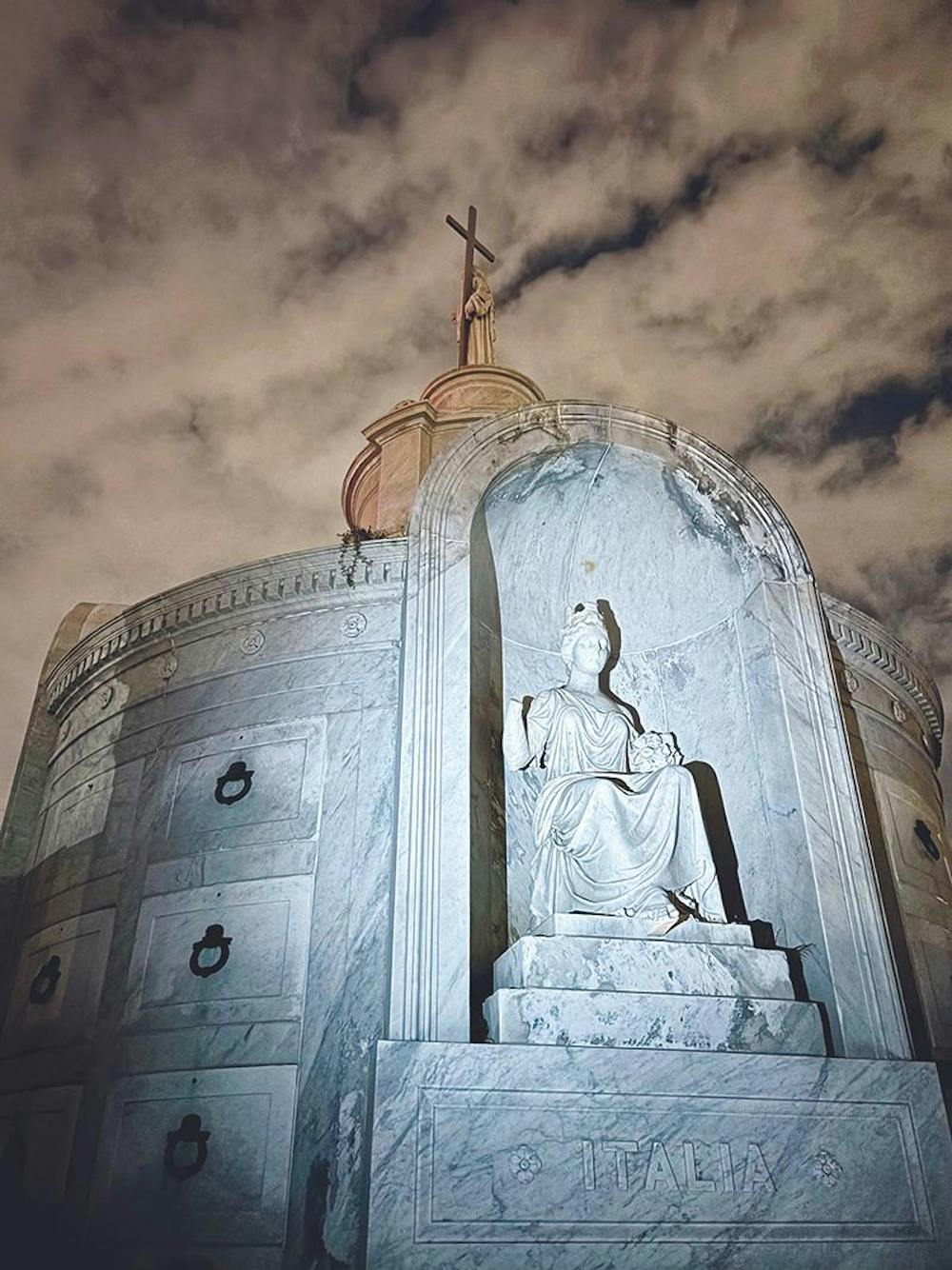
Lastly, and most importantly, you can bet your bottom dollar that your resident cemetery fanatic got herself tickets to a nighttime tour of St. Louis Cemetery No. 1. On Valentine’s Day, no less!
The cemeteries of New Orleans are undeniably iconic, enclosed in tall stone walls, with aboveground crypts and mausoleums, stuccoed gleaming white and gorgeously gothic. St. Louis Cemetery No. 1, the oldest of three cemeteries associated with the Archdiocese of New Orleans, is perhaps the most recognizable and holds some of the most famous New Orleans residents.
In 2015, the Archdiocese of New Orleans closed the cemetery to the public, following a slew of horrible vandalization of graves and properties. As such, I was unable to quietly walk through the cemetery on my own terms, but rather was led on a group tour (along with two separate bachelorette parties - lucky me). Thankfully, I couldn’t ask for a better tour guide than Mama Nita (yes, that’s her name - it's literally on her business card), a 73-year-old New Orleans native, who ran a tight ship and demanded that we leave all our questions until the end of the tour, as she was positive she’d answer them all before her time was up (she did).
As Mama Nita explained, St. Louis No. 1 is the oldest surviving cemetery in New Orleans, having been constructed outside of the city walls in 1789. Some of the most numerous additions to the cemetery were victims of the Yellow Fever Epidemic of 1853 - many infectious diseases of the 19th century made the placement of the cemetery outside of the city essential.
However, in the intervening years, the city has expanded exponentially beyond the original walls, meaning that St. Louis No. 1 is crowded into one walled city block, adjacent to a particularly busy road. So certainly not the peaceful landscapes I’m used to exploring in Michigan, but no less awe-inspiring.
Many impressive individuals are buried in St. Louis No. 1. Some include historic politicians such as Etienne de Boré - first mayor of New Orleans - and William Claiborne - the first American governor of Louisiana upon its acquisition by the US from France in 1812. Likewise, master architects, such as Barthelemy Lafon, who is responsible for much of the layout and appearance of historic New Orleans. There are also famous and infamous figures in the world of games - such as Paul Morphy, one of America’s first international chess champions, and spoiled heir Ernest Morial, who gambled his inheritance away and also introduced the European game of craps to the city.
Perhaps the most visited is the “reputed” grave of Marie Laveau, a figurehead of the city in the early 20th century who went down in history as an acclaimed voodoo priestess. Mama Nita was very quick to point out that voodoo is not some witchcraft invented by Hollywood, but rather an important spiritual practice from West Africa (Vodún) that evolved through the resilience of captured and enslaved Africans and centuries in the United States.
Regardless of the true nature of Vodún, Marie Laveau was less a priestess and more a sharp businesswoman who levied information gathered from the domestic servants of New Orleans’ elite families (some accounts claim she was a beautician by trade, after all) in exchange for fairer treatment for the Black and Creole peoples of the city. Two graves in the cemetery are attributed to Marie Laveau: the “reputed” Glapion family mausoleum and an unmarked raised crypt that’s now covered in black Xs. Or, more likely, she is not buried in St. Louis No. 1 at all.
St. Louis No. 1 is still an active cemetery. Mama Nita recalled a placement in a family crypt as recently as a few months ago. It is also subjected to the loving rehabilitation of volunteers, who work whenever possible to restore graves back to their original appearances - a variety of historical enthusiasts who can be found working not only in New Orleans, but also in cemeteries across the world. Even at home in Michigan, though, they'll have to wait until spring to get to work.