The fate of many historic homes surviving to the 21st century is a precarious one, especially ones so large and distinct as the Chadwick-Munger House of downtown Hart. Time progresses, technology improves and tastes change - and not many homeowners are in the market for a fixer-upper with shoddy electric and high heating bills, no matter how beautifully crafted the built-ins.
Some historic homes get to see a second life not as residences, but as ambassadors to the public of their significance, either historically or architecturally. Plenty of homes owned or built by important individuals act as museums to their legacy. To provide a nearby example, the Hackley and Hume homes of Muskegon are testaments to the industrial titans of West Michigan, as well as display the exquisite craftsmanship their wealth could afford. To give a far-flung and foreign example, the Atelier de Cézanne in Aix-en-Provence, France, houses the Impressionist artist’s studio in immaculate condition, contextualizing his life and work.
But many homes do not start there, especially in America in the late 19th and 20th centuries. A lot of the time, historic homes are converted into government buildings or shops or schools, with the interiors adapted to fit the needs of the new owners.
Such was the same for the Chadwick-Munger House following Dr. Chadwick and his family’s departure in 1895. The house was unoccupied until 1897, when the family of Dr. Louis Munger began renting the three-story home, a doctor’s office already conveniently inside. By 1901, the Munger family officially purchased the home.
Their improvements over the years to the house weren’t insignificant, either. The layout was rearranged so that Edith Munger, who by now was making waves in the Audubon Society, could have a library and office in the former music room (don’t mind me, just seething with jealousy). The kitchen towards the back of the house was also enlarged, as was the dining room modified. Likewise, Doc Munger spent a good deal of effort shoring up the structures in the basement, as some of the floors on the ground level were starting to sag.
Doc also added a lot of taxidermy animals, as he was an avid hunter. Personal witness testimony from Oceana County residents, who had the opportunity to see them, varies as to whether they were neat or creepy. One of the places where these animals could be found was on the newly added third floor. Finally, the stairs to nowhere, installed by a hopeful Harvey Chadwick, were given purpose, leading to a top-floor ballroom. This is also when the house’s roof was updated with its iconic pyramidic tower cap on the southeast corner turret.
In late 1958, Doc Munger passed away, and his son Robert, only two years later, from emphysema. This left Robert Munger’s wife Elizabeth with the large home, which was already costing an arm and a leg in taxes and heating bills. Elizabeth and many others in Hart feared that the distinctive home that, at the time, had stood on Dryden Street for over 60 years was fated for demolition.
However, one group came along that did need a building of that size, and it was the Church of the Nazarene, which made its interest known to Elizabeth. Elizabeth went on to provide a loan to ensure the church could purchase the property, which they did in 1962. The church removed the interior walls of the north wing on the ground floor to provide worship space, leaving the living space upstairs intact for the use of pastors and their families. Also notable were their efforts to shore up the basement supports…again.
In 1970, the church finally outgrew the Chadwick-Munger House, and the property was purchased by Oceana County, who promptly moved the Department of Social Services (DSS) from their place in the cramped courthouse basement across the street to the, comparatively, spacious three-story building. The sagging floors were noted by the DSS, but they happily spent the next several years in the Chadwick-Munger House, lowering the ceilings and installing proper air conditioning, a furnace and a burglar alarm system to protect their safe of good stamps.
In 1975, the District 5 Health Department set up shop and remained for the next decade. They inherited the offices as left by the DSS (and the squirrels that had moved in the space between the new and original ceilings), carving up the ground floor for smaller exam rooms and housing the nurses’ offices on the second floor. Alongside the squirrels was also an insect infestation to exterminate, which required some major work on the home’s frontmost walls. In 1984, the Health Department, such as with the DSS and Nazarenes, left for more suitable office space.
In 1985, the Oceana County Historical & Genealogical Society (OCH&GS) possessed several historically significant buildings in Mears, including the Swift Lathers property and the Swedish Church, but they had little room for artifacts and the growing materials making up their genealogy research collection. Understanding its importance to the history of Oceana County, the OCH&GS considered the Chadwick-Munger House the perfect building in which to begin their expansion and bought the property to usher it into its new era, where it remains today.
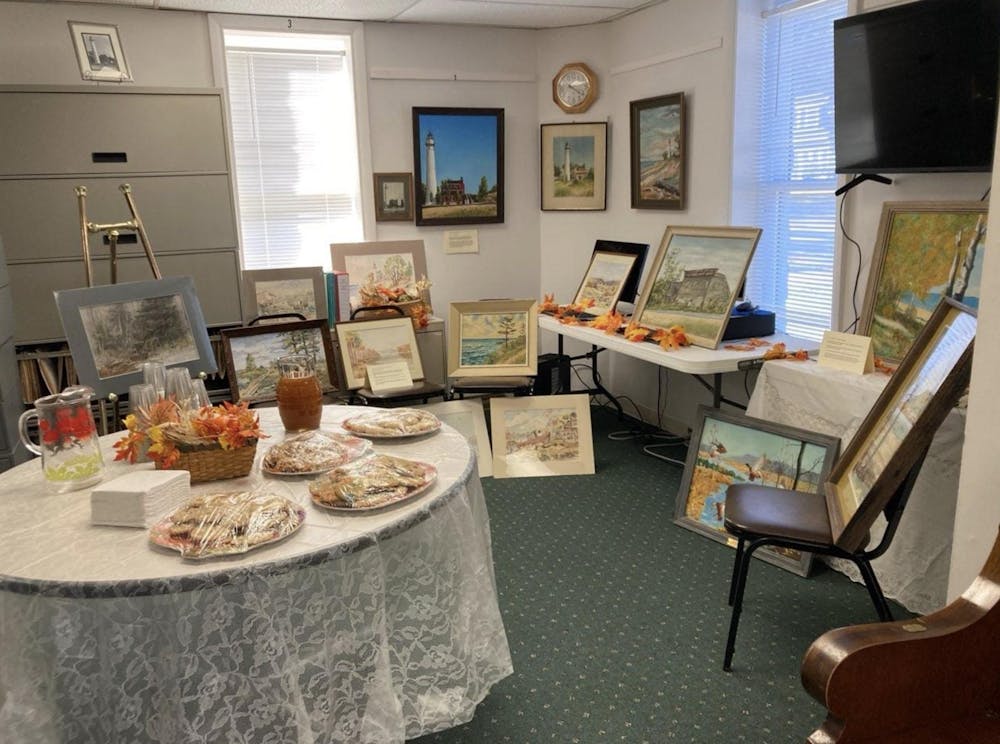
Where Edith Munger’s library once stood, there are now research stations, curated newspaper clippings and geological tomes. Where the Nazarene Church worshipped is now where you can find old yearbooks and a selection of baked goods brought in by volunteers. The bedrooms of the second floor are dedicated to archival storage, postcards, paintings and the list goes on. The old DSS office is now one of the best places to learn about Oceana County’s Native Americans. And the third floor that once housed a ballroom and taxidermy menagerie? Well, that’s none of my business.
And if you ever want to stop by on a Wednesday afternoon, I’m usually in the old doctor’s office, probably with a plateful of cookies and looking for a reason to get distracted by visitors.