Brothers Larry Byl and Paul Byl, of Shelby, sons of Pieter (Peter) Byl, and grandsons of Sybé Byl, who immigrated to America from the Netherlands, are honored to share their family’s immigration story in this second installment of The Oceana Echo’s “America 250” series.
In 1945 World War II had come to an end. But the devastation had left a permanent mark on much of Europe and the world. As countries, businesses and families worked to rebuild their lives, a unique set of circumstances began to play out, both in the Netherlands and in Michigan. Circumstances that would forever change a family’s future legacy and the history of Oceana County.
Back in the 1920s, a single woman pursuing a degree in business, Margaret De Groot, of Grand Rapids, Michigan, met George W. Welsh when she needed a job to pay her college expenses. She started as his assistant, eventually taking on more managerial roles as the years passed. In 1929, Welsh offered De Groot an opportunity to become his partner in business.
By 1934 De Groot, wanting to own a house on a lake, had bought herself a 102-year-old home and 120 acres of farmland in Rockford, Michigan, which she named Markadia Farm and where she started a dairy operation.
By 1938, Welsh was the mayor of Grand Rapids, a position he would hold until 1948. His life was one of public service, holding many prominent positions, and spearheading many worthwhile projects. While mayor, he organized the United States Conference of Mayors, which he represented as its president in tours to war-torn Europe, Asia and Africa from 1947-49. On one of those tours, at the request of De Groot, Welsh specifically went to find a Friesian dairyman to run the Markadia Farm.
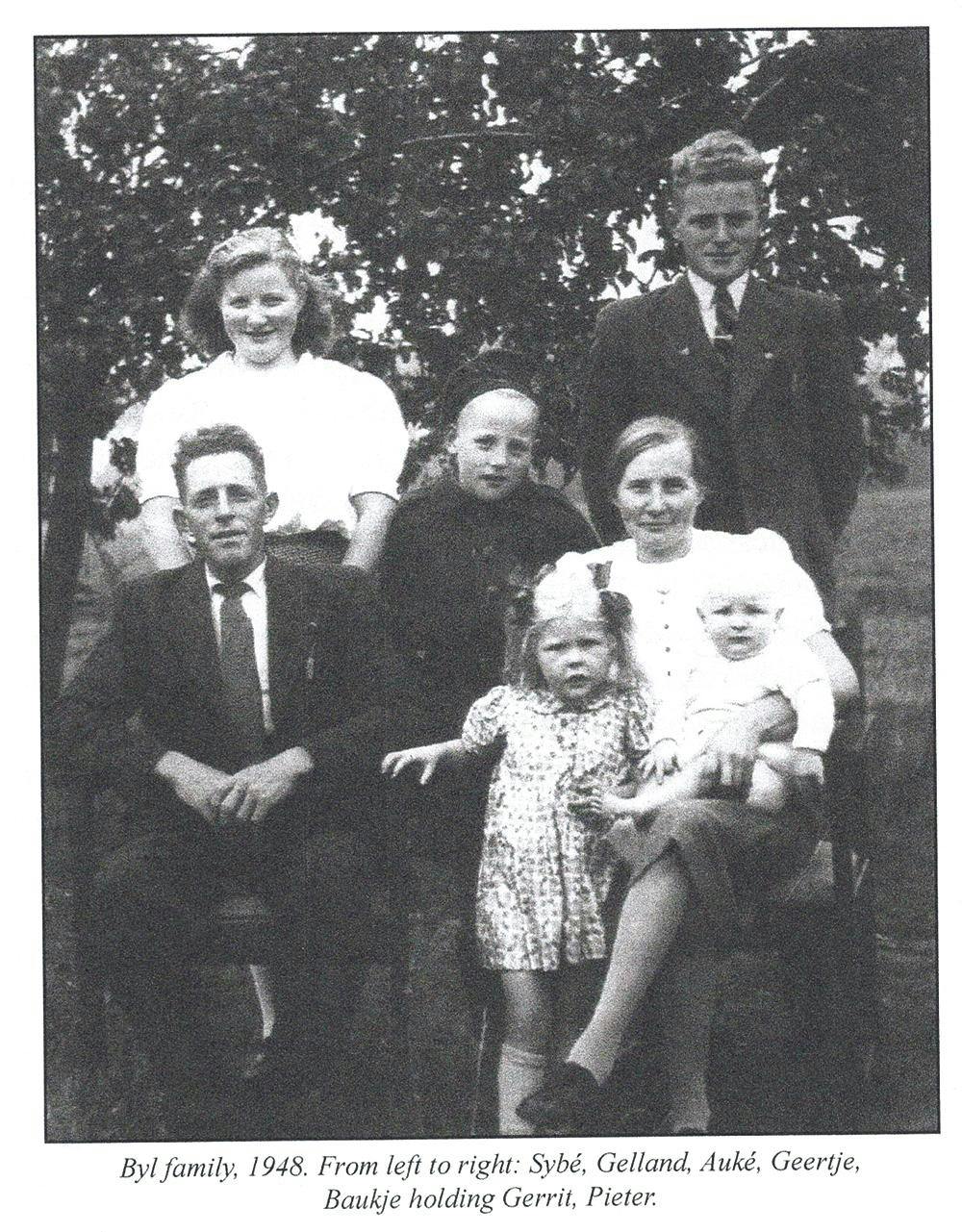
In 1948, Larry and Paul Byl’s grandparents Sybé and Baukje, and their father Pieter (Peter), along with siblings, Aunt Gelland (Jill), Uncle Auké (Sy), Aunt Geertje and Uncle Gerrit, were living in Friesland, Netherlands, a province in northern Holland bordering Germany. The family had a small farm, and Sybé worked nearby for another dairy farmer. However, his dream was to one day have a dairy farm of his own.
In the midst of war and the aftermath of German occupation, there wasn't much in the Netherlands to look forward to. Devastation was everywhere - people were hungry, everyone was on guard, Jews had to go into hiding, some were found out and innocent people were hauled away or executed. It was a difficult time in history. “Despite all of that, I have to say that all of my relatives on both sides were never mad at the Germans, but they couldn't stand the Nazis. And there's a distinction. The German people and most of the soldiers were ordinary Germans. We’re just so thankful that everybody in our family survived, and most of our relatives, except for only a few, were able to immigrate and become successful American citizens,” Larry Byl shared.
From Auké Byle’s own autobiography, “I Ran Out of My Klompen: A Personal History W.W.II Holland to U.S. 1937-1955," he recounts how everyone and everything came together. “While serving on our local district council as a representative of the De Party van de Arbeit (Labor Party), he (Sybé Byl) talked to the Burgemeister (Mayor) to ask his help in securing a sponsor to the United States. It just so happened that the Burgemeister had recently met George W. Welsh president of the mayors of the U.S.A., at a meeting. Mr. Welsh had been touring Europe to see how America might better help the war-torn countries. Our Burgemeister contacted Mr. Welsh, who responded that his business partner would like a dairyman.”
It was the fall of 1948 when the Byl family and Mr. Welsh were connected, and within days the two oldest Byl children were on their way to America. “My dad, Peter and his sister, our Aunt Gellie, flew to America, so they could start work on Markadia Farm right away. Their arrival in the United States was big news back then. My grandparents stayed back and took a couple of months to wrap up details and sell their meager belongings,” Larry said.
As fate would have it, on the family’s voyage from the Netherlands to America, they met a young woman by the name of Jakoba (Koby) Westers, who had just completed her teaching degree. But before she planned to start teaching, she wanted to travel. She had a six-month tourist visa and was planning to stay with cousins in Chicago. She became a good companion to Peter’s brother, Auké (who became known as “Sy”), a rambunctious 11-year-old who wanted to wander freely and explore the entire ship. Because his mother was so seasick and confined to her cabin most of the trip, they asked Koby to help keep an eye on him.
“Once in Michigan, my grandparents ended up inviting Koby to visit the farm. She came and ended up staying for a month, where she and our dad met. They became enamored with each other and decided to get married, at which point my mom applied for a permanent visa. That would have been 1949. My dad and the rest of his family had connections with George Welsh. So they already had permanent visas,” Larry recounted.
Because the U.S. government had a quota that would only allow so many Dutch immigrants into the country at a time, Koby would have a two-year wait. She decided to head back to Holland, where she kept busy teaching school.
Their father, on the other hand, even though he wasn't a U.S. citizen, was drafted into the U.S. Army. He was a Dutch citizen in America with an American green card. He went through basic training and was on his way to Korea, but because he knew Dutch and some German, he was shipped to Germany, where he would serve as a medic and eventually become a sergeant before leaving the Army. While in Germany Peter and Koby were able to connect briefly. In 1951, after teaching for two years in Holland, Koby returned to America, staying with the Byl family until Peter got out of the Army - another two years.
Finally, in 1953, after their four-year engagement, Peter and Koby were on American soil together and able to be married. “They had five children in seven years, Margaret, Paul, me, John and Tom. They didn't waste any time,” Larry said with a smile. “Markadia Farm sat on McCarty Lake, located at 9992 6 Mile Road, in Rockford. It was a wonderful place to grow up. We were milking 30 to 32 cows.
“Mom eventually went back to college so she could teach school in the United States. She had a Dutch four-year degree, however, that didn't all transfer. The closest college was Calvin College, and they had some staff that could read Dutch. After reviewing her transcripts, they were able to give her two years' credit toward an American degree.
“My dad, because he was in the U.S. Army, was told that military service opened the door to citizenship. They all had to get their driver's license, show education and work at it. But they all became citizens. You had people that were working to make America good, and they wanted to be a part of it,” Larry added.
“Our mom knew four or five languages: Dutch, Friesian, German, English and a little French. Sometimes our parents would speak Dutch, sometimes they'd speak Friesian, but they’d learned English and made it a very high priority that we learn English because we were in America. Education was also a priority for our family. All five of us went on to college.”
In 1955 Sybé Byl was finally able to purchase his own farm close to the Markadia Farm. Then in the early 1960s, he, along with many of the extended Byl family members who had also immigrated to America, moved to northwestern Washington State.
“Even though my mom loved agriculture and rural life, she also loved to travel. She didn’t want to be tied down too much. So the deal was if she could get a teaching degree, she wanted to buy a crop farm. And that’s how they ended up in Oceana County,” Larry said.
The couple looked at property all up and down the west side of Michigan, eventually purchasing the original farm in Benona, where Paul and his wife Anne now live. Peter and Koby rented the farm out for a year or two, while they continued to manage the Markadia Farm, and Koby finished her teaching degree.
Soon after arriving in Oceana, Koby interviewed for available teaching positions at Shelby, Benona and Ferry schools. She ended up taking a job in Ferry teaching middle school. Two years later she took a job as a fifth grade teacher with Shelby and stayed for 15 years.
“Paul was 10 and I was 9 when we first moved to Oceana County. Later, one of our first off-the-farm jobs was for Vernon Bull, now Cherry Point Farm & Market, just down the road from where we lived. It was another farm, but it's where we got paid real money,” Larry laughed. “The original farm raised apples, peaches and cherries. Back then, there were lots of small farms. You just all pitched in. Everybody did it.Then shortly thereafter, Dad bought another farm close by, and that's where he started raising asparagus.”
When asked what legacy they feel has been passed on and they are continuing, Larry reflected, “Obviously, from my dad's side of the family, farming was extremely important. It was important for them to see a farmer emerge with each generation. And that is still taking place today. Both Paul and I have had our own farms. And now my oldest son, Ben, is a full-time farmer. From my mom's side, I would say education was her legacy. It was important to her that we equip ourselves by going to college or trade school so that we could be productive. All of my relatives have had a strong work ethic. I can't overemphasize that. And after reading Sy’s book, one can see our extended family had a strong faith as well. They needed that especially to survive the war. Faith, family and farming - I guess you could say that is our legacy."
The Byl family history from Larry and Paul Byl’s Uncle Sy’s perspective is recorded in a book entitled, “I Ran Out of My Klompen: A Personal History, W.W. II Holland to U. S., 1937-1955” by Auké “Sy” Byl and is available for checkout at the Shelby Area District Library in Shelby.