Three women with deep connections to Pentwater have been posthumously nominated for the National Society Daughters of the American Revolution Women in American History Award by Shannon Larson of the Michigan Dunes Chapter NSDAR.
Anna Barbara (Jensen) Switzer, Nina DeLong Sands and Mattie (Miller) Blitz followed very different paths, but each made contributions that extended far beyond the small West Michigan community they once called home. Their stories demonstrate the influence women from these communities could have during a period of enormous change in American life
The DAR Women in American History Award recognizes women who have made significant contributions to their communities and the nation, but may not have received the recognition they deserved during their lifetimes. Larson and the Michigan Dunes Chapter hope to bring renewed attention to these women whose accomplishments deserve to be remembered by their own names and for their own achievements.
Anna Barbara (Jensen) Switzer:
Pioneer in nursing
Born in Pentwater on July 23, 1870, Anna Barbara (Jensen) Switzer graduated from Pentwater High School and worked as a teacher in Golden and Weare townships before pursuing a career in nursing.
In 1894, she enrolled in the Illinois Training School for Nurses in Chicago, one of the country's pioneering nursing schools, graduating in 1897.
When the Spanish-American War began the following year, Switzer answered the call to serve. In August 1898, she enlisted as a U.S. Army nurse and was assigned to Camp Wikoff at Montauk Point, New York, where thousands of sick and exhausted soldiers were arriving from Cuba. Despite being only a year out of nursing school, she was placed in charge of three wards.
Her service later took her to Havana, Cuba, where she continued caring for soldiers under difficult conditions and became seriously ill herself.
After the war, Switzer served in supervisory nursing positions at hospitals in Chicago before marrying physician Dr. George Oscar Switzer in 1900 and settling in Ludington.
At a time when Ludington had no community hospital, Anna cared for patients upstairs in the Switzer home when they were too ill to remain in their own homes. She became instrumental in efforts to establish Ludington's first community hospital in 1906.
Switzer also helped advance nursing as a profession and eventually served as president of the Michigan State Nurses Association. She remained active in veterans' organizations throughout her life and died in 1965 at the age of 94.
She is buried in Pentwater Township Cemetery, near the very place where her remarkable life began.
Nina DeLong Sands:
Education, civic leadership and women's suffrage
Nina DeLong Sands helped give women a voice at a time when they did not yet possess the full rights of citizenship.
Born in Muskegon on March 30, 1877, Nina was the daughter of Nelson and Jenny Lind McCartney DeLong. She graduated from Muskegon High School in 1896 and that same year married Herbert F. Sands, a member of Pentwater's prominent Sands family.
In 1898, Sands became a charter member of the Pentwater Women's Literary Club, which promoted literary and scientific study while also becoming a force for education and civic improvement in the community.
In 1907, Sands was elected to the Pentwater Board of Education, where she served until 1912, including terms as secretary and treasurer. She was identified in contemporary accounts as the first woman elected to the board following changes in Michigan election laws.
Her leadership soon extended beyond Pentwater. Sands became active in the home economics movement, serving as president of the Pentwater Home Economics Club and Oceana County Federation of Women's Clubs. She also held leadership positions in the Michigan State Federation of Women's Clubs and became known as a lecturer and writer on home economics.
Most significantly, Sands became an active advocate for women's suffrage.
By 1912, she was a member of the Speakers' Bureau of the Michigan Equal Suffrage campaign and was documented as having delivered numerous addresses supporting women's right to vote.
Her work continued a remarkable Pentwater connection to the suffrage movement. Susan B. Anthony spoke at Pentwater's Rice Hall in 1879. A generation later, Sands was among the Michigan women carrying that cause forward.
Michigan women gained the right to vote in 1918, and the 19th Amendment secured women's voting rights nationally in 1920.
Sands lived until 1969, witnessing changes in women's education, civic participation and political rights that she had helped advance.
Mattie (Miller) Blitz:
Musician, educator and woman of courage
The story of Mattie (Miller) Blitz was rediscovered in an unusual way: through a small headstone in Pentwater Township Cemetery bearing only the name "Madame Edouard Blitz."
During a June headstone cleaning event hosted by the Michigan Dunes Chapter and the Friends of Pentwater Township Cemetery, Shannon Larson and Scott Burrows became curious about the woman buried beneath the marker.
Research revealed an extraordinary story.
Born in Mansfield, Ohio, in May 1865, Mattie later moved with her family to Pentwater, graduated from Pentwater High School and attended Eureka College in Illinois. Contemporary accounts described her as highly educated, accomplished in languages and a talented musician.
In 1884, she married Belgian violinist Edouard Emanuel Blitz in Pentwater. The couple traveled to Belgium, where Mattie continued her musical studies and their son, Julien Paul Blitz, was born.
While Mattie was in Ghent, Belgium, she reportedly saw a woman and child fall in the street in the path of a runaway horse and carriage. Mattie, who was an experienced horsewoman, ran into the street and stopped the horse, saving them from danger. For her bravery, she was honored by the Belgian government with the Médaille Civique, a civic decoration awarded for acts of courage.
Recent research has added new documentation to this remarkable part of Mattie's story. A contemporary American newspaper reported that Mrs. Edouard Blitz, formerly Mattie Miller, had received Belgium's Médaille Civique "for an act of courage." Belgian records also document a Royal Decree dated July 18, 1894, during the reign of King Leopold II, granting civic distinctions for "acts of courage and devotion." Historical accounts identify Mattie as the first American woman to receive the honor.
After returning to the United States, Mattie and Edouard eventually joined Cottey College in Nevada, Missouri, where they established the college's Conservatory of Music. Mattie taught piano there for nine years, helping provide advanced musical education to young women during an era when professional opportunities for women were limited.
Mattie died in 1904 at just 39 years old and was returned to Pentwater for burial.
Mattie’s musical legacy continued through her son, Julien Paul Blitz, who became an accomplished cellist and conductor and went on to serve as the founding conductor of the Houston Symphony Orchestra.
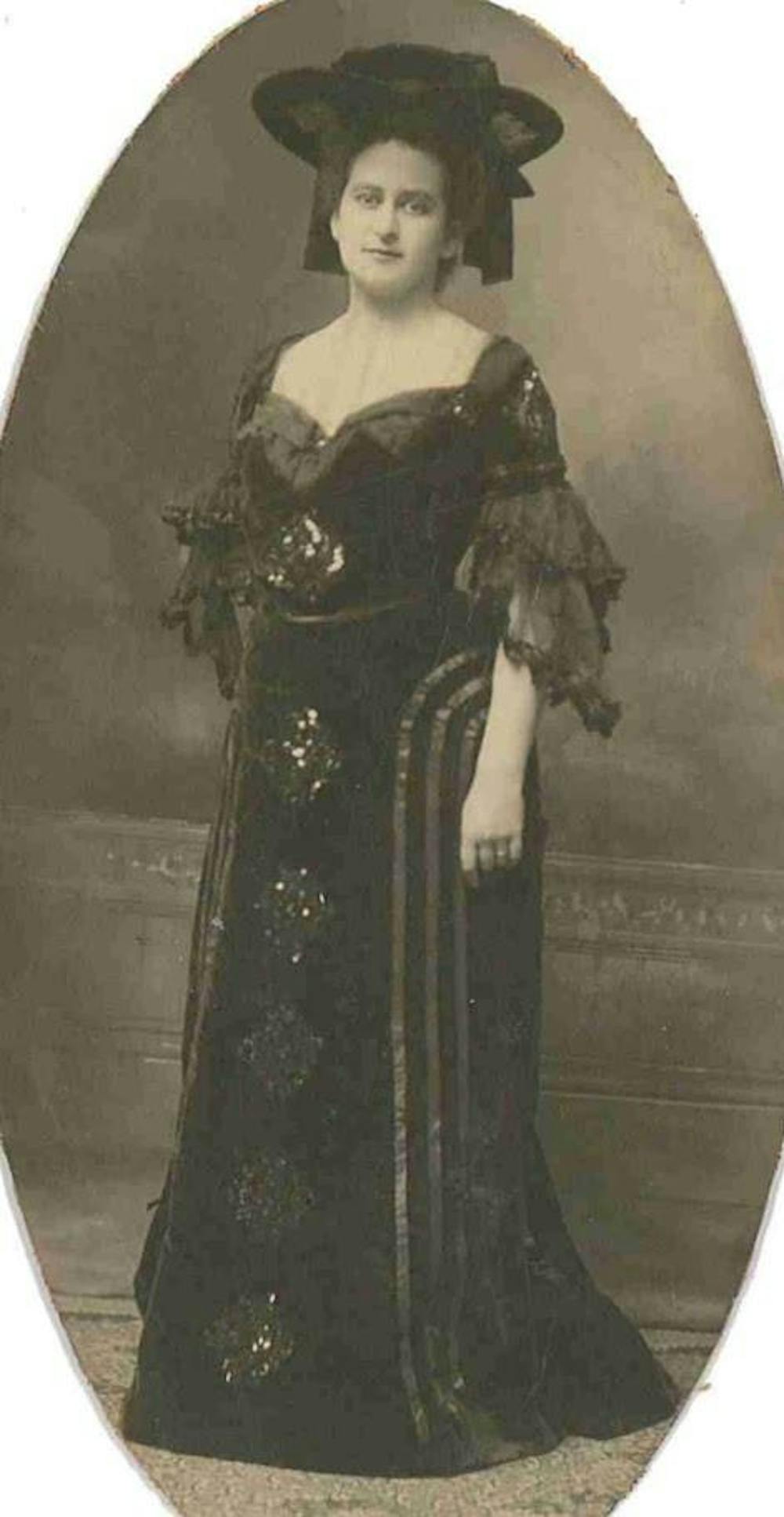
The effort to rediscover Mattie's story has also led to an important connection with Cottey College. Larson contacted the college seeking information about Mattie's years there. Office Manager for Institutional Advancement April Brown and the college archivist searched Cottey's historical records and located a photograph of Mattie. Brown provided the photograph to Larson, allowing Mattie's image to be shared along with her story more than a century after her death.
Michigan Dunes Chapter also plans to send Mattie's Women in American History Award certificate and nomination information to Cottey College, where her contributions as an educator and musician can continue to be remembered.
What began with curiosity about a small cemetery marker identifying a woman only by her husband's name has helped restore Mattie (Miller) Blitz's own name, her face and her remarkable story to history.