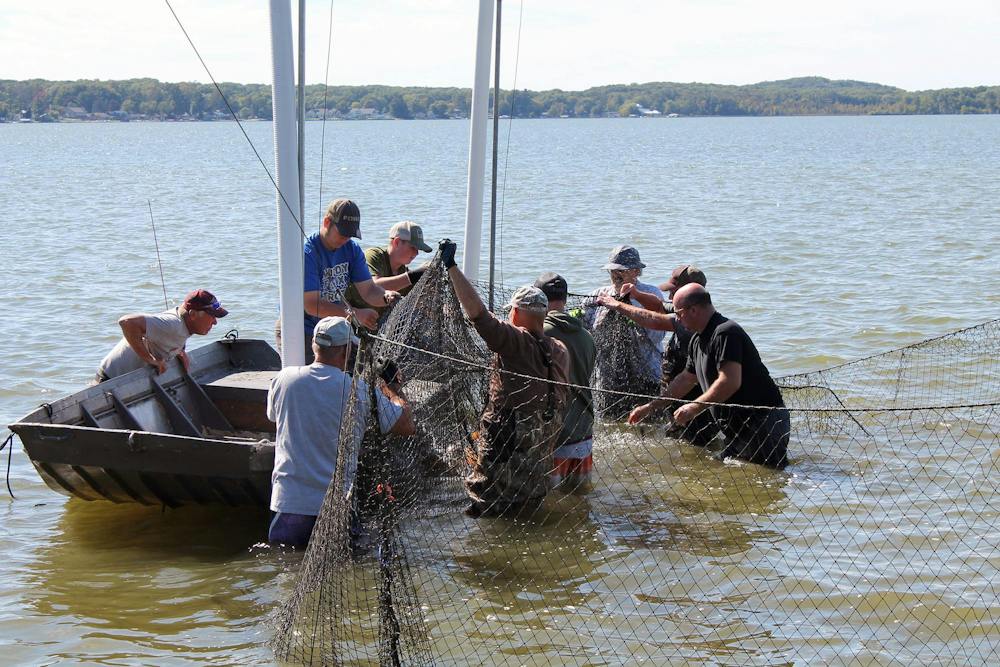
The afternoon of Sunday, Sept. 27, was the final haul of the most recent and successful attempt to cull the nuisance carp population from Silver Lake. This new method employed in a joint effort between the Friends of Silver Lake and the Silver Lake Improvement Board is surprisingly simple: a large net, baited with a couple bags of cracked corn. What the net lacks in sophistication, it more than makes up for in the sheer volume of fish being removed from the lake, with 15,247 pounds of carp harvested across 12 weeks, amounting to over 3,000 fish.
The project was spearheaded by Marty Hayden, board president of the Friends of Silver Lake, who has been working for years on how to improve Silver Lake’s carp overpopulation. Previous attempts, more glamorous and expensive, have been rounds of electrofishing, where an area of water is shocked with a direct current to stun fish for collection. Over two years, this attempt yielded a catch of no more than 30 total fish.
Also organized was an annual Kids Carp Cull every June, where anglers under 16 were invited to catch, collect and turn in carp at $2 a head. These events fared better, wrangling in a couple hundred fish, with June 2026 netting about 75-100 fish. Even though the efforts of a few industrious adolescents may not significantly impact the overall nuisance population, Hayden said the Kids Carp Cull is more important for outreach and for stressing the overpopulation issue to the community.
Overpopulation is certainly a foreboding word, but what does that look like regarding the carp in Silver Lake? It looks like a dramatic shift in the ecosystem of the lake, from vegetation to native fish populations. Carp are bottom-feeders that uproot and prevent native vegetation from taking hold. This vegetation is integral to the sustaining populations of native fish commonly enjoyed by anglers: bass, walleye and bluegill. The agitation of sediment also drastically degrades the water quality of Silver Lake, leading to cloudy water.
This is not an issue exclusive to Silver Lake, as plenty of bodies of water across the Great Lakes region suffer from similar overpopulations; Minnesota in particular. In fact, Hayden got the idea to try the net in Silver Lake from watching videos of carp culls in Minnesota. He reached out to Carp Solutions, a Minnesota-based company dedicated to providing tangible solutions to overpopulation.
However, neither the Friends of Silver Lake nor Carp Solutions were certain that the methods that worked in Minnesota would also be effective in Michigan. As explained by Chuck Persenaire, of the Silver Lake Improvement Board, “Spawning on every lake and every season is a little bit different. It’s all weather-related and water-temperature-related…"
Before the net was brought in, Carp Solutions recommended a trial run to see if the carp actually could be baited. Last fall, the Friends of Silver Lake baited the water over a period of two days, to great results and the consumption of over a hundred pounds of corn. This success was then presented to the Silver Lake Improvement Board, who in turn provided the funding to lease a single net at $5,000.
The culling would have to wait until mid-summer, as carp spawning can start as early as April and run until mid-June, displacing populations from their expected spots in Silver Lake and rendering the net ineffective. It wasn’t until after the Fourth of July that Carp Solutions’ net was set up, but the results were immediately apparent with an inaugural haul of 800 pounds of carp.
The weekly process is simple. The net is baited throughout the end of the week and the weekend, starting on Thursday. In the early hours of Monday morning, the net is set to spring, trapping the fish. Several hours later in the late morning or early afternoon, volunteers arrive to retrieve the carp, wading in the water and rolling the net up, herding the fish to one end where a flat-bottom boat awaits. The fish are then rounded up into the boat, layers upon layers carpeting the hull, sometimes reaching the tops of the seats. Weights and lengths of the largest and smallest specimen are taken, providing precise, scientific numbers for the culling efforts. The weight of the overall haul is taken as well before the boat is hauled off to dispose of the fish.
Disposal is provided by Tim Beggs, business owner and county commissioner for Golden Township, who has been another steadfast supporter of the carp culling project. Beggs has been privately disposing of the fish himself, using the dead fish to make compost. While Beggs is more than happy to collect thousands of pounds of fish throughout the summer, Friends of Silver Lake and the Silver Lake Improvement Board are also considering finding other commercial uses for the fish, perhaps offering the hauls to fertilizer or pet-food companies.
Perhaps the most unexpected result of this year’s cull is the local interest, with crowds arriving every Monday to watch. For Hayden, who was interested in educating the community, the outreach is invaluable. "It's been great to see how the community has kind of rallied around this. We’ve got a lot of people who really want to help improve the lake. If we can get this population down, hopefully we can see some more native plants come around and fishery improving.”
Persenaire described the number of onlookers and their surprise over the community interest, “We thought, you know, we should start charging attendance and selling coffee, and maybe we’ll pay for it [the net] that way with the amount of people that were showing up just to watch.”
The community interest also yielded an influx of volunteers, which are necessary to the cull’s operations, as it's the volunteers who are getting in the water, transferring the carp from the net and into the boat. There were 11 volunteers on Sept. 27, just a handful of the list that rotated weekly throughout the summer.
For one volunteer, who lives just down the street from the Taylor Road boat launch, it may have been the last haul, but it was his first day helping out. The issue hits close to home for him, as he said he fishes Silver Lake often, and “in the last 40 years it’s really (gone) downhill. Every year it's less and less. There’s no bluegill here anymore. The crappie are almost gone (and the) perch are wiped out. (The) only thing left is carp, the occasional bass and walleye, (and) that's it.”
Future volunteers can sign up on the Friends of Silver Lake website at friendsofsilverlake.org.
With autumn arriving in full force, Silver Lake has seen its fair share of seasonal changes, accounting for the lowest haul on Sept. 27. Volunteers wrangled only 19 carp into the boat, with the largest weighing in at 8 pounds and measuring 28 inches in length. Volunteers spent the rest of their time disassembling the net for the season. The low turnout that day did nothing to dampen the spirits of organizers, however. Hayden is proud of the groups’ experiment and is looking forward to leasing another net next year.
Beggs agreed, “This has been our most successful so far… it's been a learning experience. Hopefully it’ll be even more successful next year.”