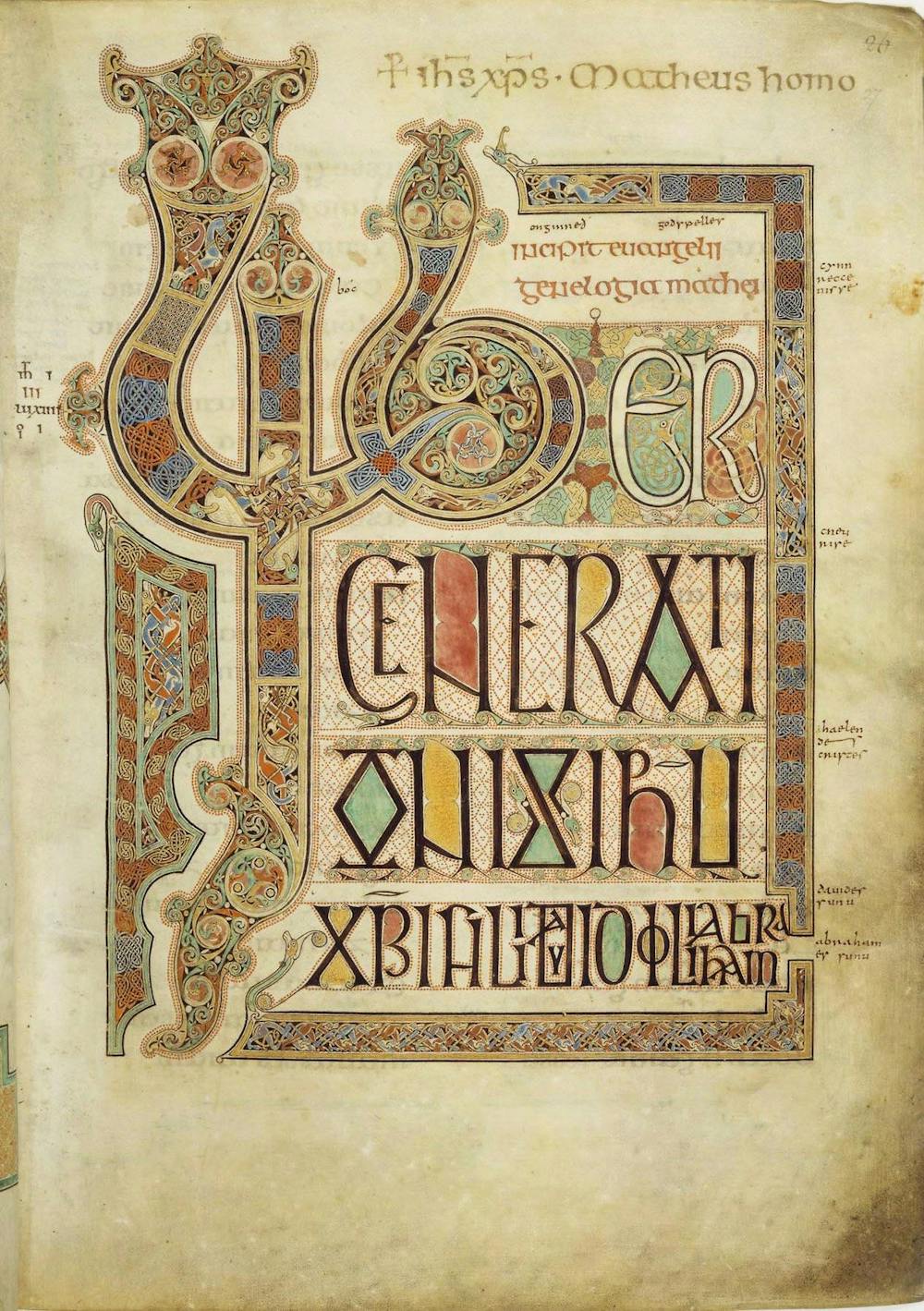
In celebration of the final birthday of my 20s, it’s only fitting that I hold my readership captive with the historical subject that consumed the majority of my past decade of life - illustrated manuscripts. Some readers may recall that I cut my academic teeth studying medieval art history (any snide remarks on my choice of college major will require joining the bracket for my upcoming jousting tournament), and I’ve been subsequently introduced to dozens upon dozens of illustrated manuscripts, two of which were the subject of my master's dissertation.
So, without further ado, here are some manuscripts I’ve studied that I think you should check out.
The Lindisfarne Gospels are the oldest example on our list, having been created in the early eighth century at the Lindisfarne monastery in England. It is a beautiful example of insular art - the art of early Christians of Great Britain and Ireland - and showcases the trademark interlace designs, those interlocking loops commonly associated with Celtic art. While every page in the Gospels is a masterpiece, the carpet pages are unimaginably spectacular, with intricate and hypnotizing detail work that makes your brain hurt if you think about it too much. Carpet pages are a staple of insular manuscripts - the “carpet” referring to their inspiration from Middle Eastern textiles - and are typically placed between chapters of the Bible (in this instance, the Gospel chapters of the New Testament) to act as a sort of divider between narratives and an opportunity for the reader to meditate and pray.
The Lindisfarne Gospels were decorated with a demure layer of gold leaf and were likely bound in a jewel-encrusted cover (thought to be pilfered during Viking raids on Lindisfarne in the late 700s). The Lindisfarne Gospels were created for use in the monastery, one of the more common contexts in which you’ll find illustrated manuscripts, and were dedicated specifically to the honor of God and St. Cuthbert. After the Viking invasion of Lindisfarne’s island, the codex migrated with the holy order to Durham, England until the dissolution of monasteries (that’s a whole other story; it's one of the things Henry VIII was up to when not divorcing or executing wives), and the book fell into the hands of private collectors (a common fate for many medieval manuscripts in the 17th, 18th and 19th centuries). Now it is part of the expansive collection of the British Library in London, known under its shelfmark British Library, Cotton MS Nero D.IV.
The next manuscript is one of three codices that feature an Arabic love story, the tale of Bayad and Riyad. This manuscript in particular - Haddith Bayad wa Riyad (or Vatican Library, Vat.ar.368) - is the only version that is both illustrated and has a happy ending (like a Disney movie). The manuscript comes from 13th-century al-Andalus (the Islamic territories of southern Portugal and Spain during the Middle Ages) and clearly sets its story in the region with specific renderings of Andalusi architecture. The art style itself more closely resembles that of the Near Eastern cultures of Syria and Iraq. This is significant, however, as traditional Islamic art rarely (not never, but rarely) features figurative drawings, more renowned for pattern work and calligraphy. The result is a stunning cross-cultural chimera of artistic styles, palettes and visual languages that mirror the variety of peoples living in al-Andalus throughout the medieval period, namely Muslims, Christians and Jews.
The context under which the Haddith Bayad wa Riyad was made is a mystery. No craftsmen or patron has ever been identified within the manuscript itself, and no contemporary documentation hints at who may have made or owned the piece. It is currently housed in the Vatican Library. The question of how it got there can be answered by scholars with a big shrug and “I dunno.” There’s a couple of options: Crusades or the Conquest of Tunis. Either way, someone surely got stabbed over it. But regardless of its mysterious origins and journey across the continent of Europe, what is for sure is the manuscript's significance as one of the few surviving examples of an Arabic manuscript made in al-Andalus.
I would never pick a favorite manuscript, but I cannot deny that the Trinity Apocalypse holds a very special place in my heart, especially as the subject of both my undergraduate thesis and master's dissertation. The Trinity Apocalypse (Trinity College, MS R.16.2) was made between 1255 and 1260 in England and is a key example of a surplus of apocalypse manuscripts made in 13th-century England. While the Christian Apocalypse has been a popular subject for religious art since its inception, it’s rare we see medieval manuscripts solely focused on the events of the Book of Revelation. In fact, 13th-century England and 10th-13th-century Spain are where the majority of these examples were produced. What’s more, the Trinity Apocalypse is so unique because it is the earliest known example of an English apocalypse manuscript and clearly bears resemblance in both style and symbolism to earlier Spanish apocalypses, with bright, flat colors and patterned backgrounds.
Trinity is an example of a manuscript that was made for a wealthy patron, likely nobility. The inclusion of women as key figures in several scenes has also caused scholars to wonder whether the patron was a woman. Several wealthy noble women of 13th-century England have been posited as the intended patroness of the manuscript, one of them being Queen Eleanor of Castile, wife of King Edward I of England (he was the antagonist fighting against Mel Gibson in "Braveheart"). Eleanor of Castile is the option I agree with most (and which I’ve similarly argued over tens of thousands of words of research papers), due to her origins as a Spanish princess, who was a celebrated patroness of the art. This would account for the remarkably Spanish appearance for an English-made manuscript (anyone looking for further details, email me for a PDF of my dissertation, at your own risk.)
So for my birthday, if you wish to celebrate your favorite history columnist, please visit a cemetery, scroll through Wikipedia late into the night, or check out any of the above manuscripts, all conveniently digitized for the public and provided through the websites of their home libraries.