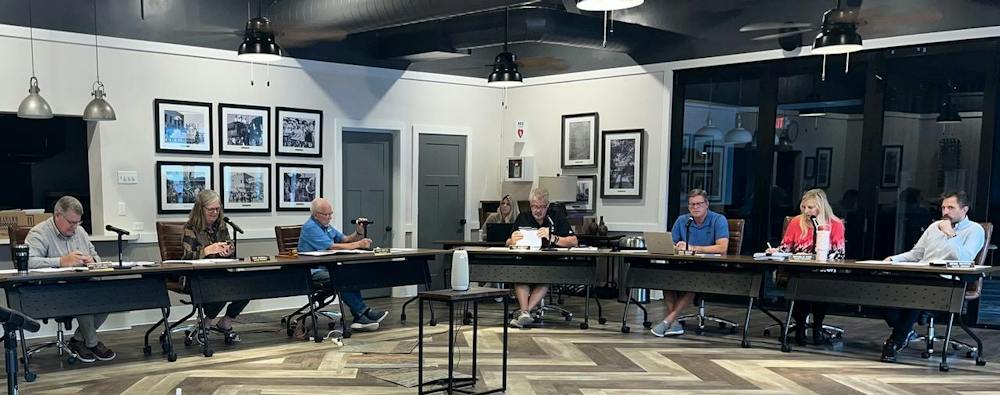
The Pentwater Village Council met Monday night, Oct. 12, at 6 p.m. for nearly two hours with an audience of 27 persons, many of whom came to hear the discussion and decision about Flock Cameras that was on the agenda. All Council members were present: David Bluhm, Jared Griffis, president Mary Marshall, Dan Nugent, Kathy O’Connor, Don Palmer and Karl Schrumpf.
Public comments on agenda items included reasons to discontinue Flock Cameras, spoken by Mike Wallace, Tara Perez and Vaughn Thurston-Cox. Following the request to move one item to new business, the consent agenda was approved.
Correspondence included a letter from Ted Cuchna with three concerns, including the new leaf pickup policy. A letter was also received from the Sport Fishing Association with a check enclosed for $2,000 for the fish cleaning station.
The Pentwater Fire Department’s report included news that bylaws were completed for the West Michigan Fire Authority, and the new entity would officially begin service on Nov. 1. The police department’s report included news that the no-wake buoys had been removed from Pentwater Lake, signaling the unofficial end of the boating season. Discussion of the Flock Camera recommendation and a report from Zoning Administrator Aaron Bigelow that included three proposals for ordinance amendments were both addressed under New Business.
With no committee reports, public hearing or unfinished business, Marshall moved to the list of seven items under New Business. A request from DTE to move the gate valve station from its Monroe Road location to the front of the DPW building was tabled until November to explore what implications the move might have for the DPW staff. This was followed by a presentation from the Gabridge & Co. audit services that highlighted any notable changes in financial patterns and differences from last year’s balances. The presenter complimented Michele Bieri’s work and the assistance provided by Peter Tierney of Fleis & VandenBrink. He had no specific concerns or recommendations to offer.
The next three proposals came from the zoning administrator regarding amendments to the solar ordinance, the sign ordinance and the special land use ordinance. The last of these offered a six-month extension to the normal year allowed to complete projects, recognizing possible delays in obtaining required permits and inspections.
Another item was the Flock Cameras. Police Chief Laude Hartrum reviewed the 90-page report (posted a day later on the department’s website) and the quantity of feedback from the community. He attached copies of every message he received for council to see. He presented his recommendation to discontinue use of the Flock Camera system and his reasons for doing so. He stated emphatically that no village funds had been spent on the experiment and it accomplished the goals set for it: to try it out and see if it was a system worth continuing.
He reminded the group this experiment was not the first time the village had used surveillance systems, and that forms of surveillance are in use many ways throughout society via Ring cameras in homes and businesses, through fingerprints and DNA, facial recognition and increasingly complex systems people may not even be aware of. He said that to ignore the development and evaluation of and participation in the movement is a disadvantage.
The comments received noted how the advancement capabilities of surveillance raise moral questions and implications. Currently there is concern regarding if Flock Cameras have sufficient control over data, how long it is kept, how it is analyzed and how it is shared. Two lessons of Pentwater’s experiment Hartrum shared were that the placement of cameras in residential areas held no value and that any future use of similar surveillance systems needed to have a civilian oversight committee. The need for better control of data, the negative responses of the community, and the very high cost ($24,000/year) were Hartrum’s reasons for his recommendation. Council voted unanimously to approve the recommendation. Marshall wanted to state that if Pentwater could employ a surveillance system in the future over which they could hold singular control, it would be valuable to the community in cases of missing children or elderly adults with dementia.
Marshall introduced a discussion on an offer from a developer for the 327 Hancock property, the former village office. Manager Toby Van Ess explained the offer included $250,000 to purchase 330 Hancock, the parking lot next to the Chamber of Commerce office. Legally bound to privacy regarding the developer’s plans for 327 Hancock, Van Ess could only say that the developer’s funding for these plans was dependent on having guaranteed parking for 25 vehicles. Denying the purchase of public parking would likely mean passing on the purchase of 327 Hancock. Council members were not persuaded to approve the offer for both properties. After a long discussion, Nugent proposed a meeting of the Building and Grounds Committee on Oct. 16 to explore any other parking options that might exist.
The second opportunity for public comment yielded appreciation for Hartrum’s report and recommendation, a question about what location was available for residents to dump leaves, an affirmation of a Trick or Treat event in the village from 5-7 p.m. on Oct. 31, and disappointment from a Spinnaker condo resident about the lack of information for their residents on plans for 327 Hancock since it would inevitably impact their parking. A Chester Street resident also expressed continued concern about well 4 water and his hope that it would not be an ignored topic.
Council comments included thanks to Hartrum. Marshall read a long letter she wrote to share her concern for the fiscal challenges the village has due to the income under which it operates compared to the expenses it faces. She listed the tax mills of neighboring municipalities, which exceed Pentwater's by 2-5 mills. When Pentwater residents complain to her that “nothing is happening here” compared to recent improvements in downtown Hart and downtown Shelby, she wants to explain the reasons. Those communities received Covid funds, and Pentwater did not. Their annual income is comparatively higher. She invited council members to a retreat (to which residents would be welcome) on the first Monday in December to discuss village finances. In particular, they would examine a document from Van Ess entitled "State of the Village."
The manager’s comments included an explanation of the aforementioned document. He also shared news of hiring a new DPW employee, Chad Harmon, along with upcoming hydrant flushing and Oct. 15 park shutdowns. He reported working with EGLE to shut down well 1, which has not been used due to lead content. Recent tests of well 4 use show a slightly higher iron content on Chester Street, but not in the village, where it is mixed with well 2 water.
The meeting was adjourned at 7:48 p.m.