It’s one thing to read about history or to look at historical objects in a book or online, but it's another thing entirely to experience history up-close and tactile. In a similar vein, I think we may sometimes take for granted the stories we hear from our veterans - “Oh boy, here goes Grandpa launching into his old war stories again!” - not fully comprehending the reality until we handle an enlistment card or see snapshots of a battleship.
It’s not common knowledge (or at least, not as common as I’d prefer it) that the Oceana County Historical & Genealogical Society (OCH&GS) has archival boxes upon archival boxes of any subject you could comprehend related to Oceana and its historical residents. One shelving unit is almost entirely dedicated to military history artifacts, donated by Oceana County veterans and their families. For Veteran’s Day, let's take a look at just a fraction of the treasures one can uncover sifting for an afternoon through OCH&GS archives.
• First, is a Civil War Muster Roll certifying the presence of Private George Rachel, of the 6th Michigan Cavalry, Company I, at Camp Kellogg, Grand Rapids, in December 1862. Some of the battles in which the 6th Michigan Cavalry fought include Gettysburg and Appomattox.
• Next, is a Grand Army of the Republic (GAR) medal and ribbon for the “Joe Hooker” GAR Post No. 26 of Hart. Joseph Hooker was a Union General, who is known for his defeat of Robert E. Lee at the Battle of Chancellorsville. The GAR post is named after him, likely by veterans who served under Hooker.
• A section of an approximately 48-inch-long panoramic photograph of the 4th Battalion Infantry and 23rd Engineers in March 1918 can be seen at the top of the next column. The 4th Infantry Regiment has been a part of the United States Army since 1808. When the U.S. entered WWI, this regiment fought in and occupied France until 1919. The 23rd Engineers contributed to the war, also in France, through constructing key infrastructure like roads and bridges.
• Below, is a souvenir handkerchief from France, trimmed with lace and the year “1919” embroidered with the Allied flags, including France, Belgium, the United States and Great Britain. The handkerchief was donated to the historical society by Mary Peterson.
• Next, is the draft notice for Basil S. Dempsy of Hart, which is dated August 13, 1917. The draft requires Basil to attend a physical examination within seven days.
• Enlisted Men’s Club membership card of Edwin Schaner in Asaka, Japan, dated January 1946, during the American post-war occupation of the country. Both enlisted men and officers had separate social clubs for soldiers to rest, relax, drink and dance. Asaka is located a short distance north of Tokyo. The backside of the card, as seen below, has the same information printed in Kanji.
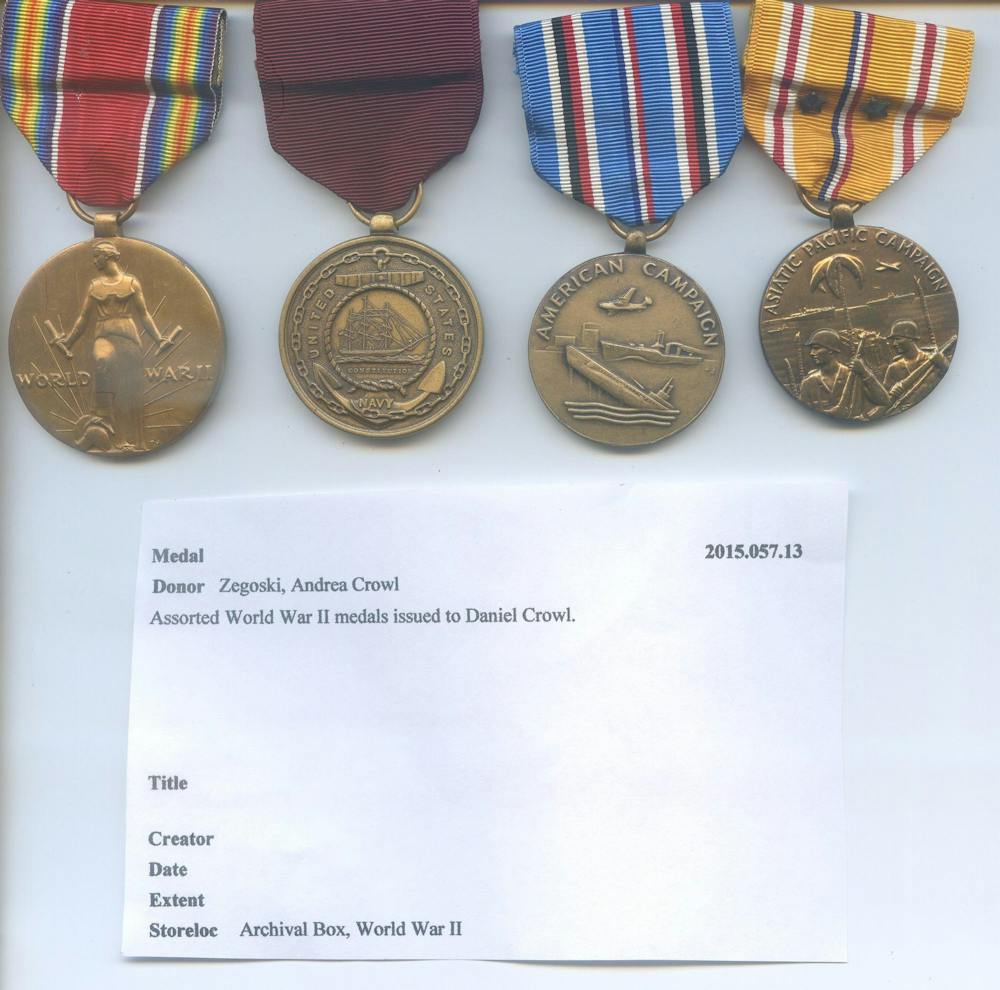
• Next , are a line of medals awarded to WWII Navy Veteran Daniel Crowl. Two of the four medals denote the campaigns (American and Asiatic Pacific) in which Crowl served.
• Below, is sheet music for the “Song of the Seabees,” which was a Naval construction battalion in WWII. These were printed for use at enlistment stations throughout the country. The bee mascot is wearing a Navy “dixie cup” cap and is holding a hammer and wrench, and shooting a stylized Thompson submachine gun. In nature, bees don’t use construction tools or firearms.


• Finally, we have a pack of official V-Mail stationary, which included letter sheets, envelopes, and some stickers. This standardized stationary was issued and used by soldiers during the war, the “V” standing for “Victory.” A single letter sheet could hold about 300-700 words, depending on how small your print was. I can hardly manage to limit myself to 1,000 words per article every week.
These scans represent just a fraction of what the historical society archives have to offer. If you are interested in checking out more, the archival boxes I explored are located at the Chadwick-Munger House in Hart, which is open every Wednesday from 10 a.m. to 5 p.m.
The OCH&GS is always accepting donations of historical items, and those can also be dropped off on Wednesdays.