L.M. Montgomery’s 1908 novel "Anne of Green Gables" is a mainstay of North American children’s literature. It follows the titular heroine, orphan Anne Shirley, as she’s brought to the Canadian province of Prince Edward Island to her new adopted family, middle-aged siblings Marilla and Matthew Cuthbert. At the train station, however, Anne and her new family come to realize a miscommunication has occurred - the Cuthberts had specifically ordered a boy to help with farm work, and Anne, a precocious chatterbox with a vivid imagination, is certainly not that.
Regardless, after much convincing from Matthew to Marilla, Anne stays with the Cuthberts, who come to love her as their own. Her story follows her childhood as she explores the town of Avonlea, meets her quirky neighbors, makes "bosom" friends (such as Diana Barry) and mortal enemies (such as Gilbert Blythe), and grows into an intelligent young lady who defied the social conventions of the early Edwardian era.
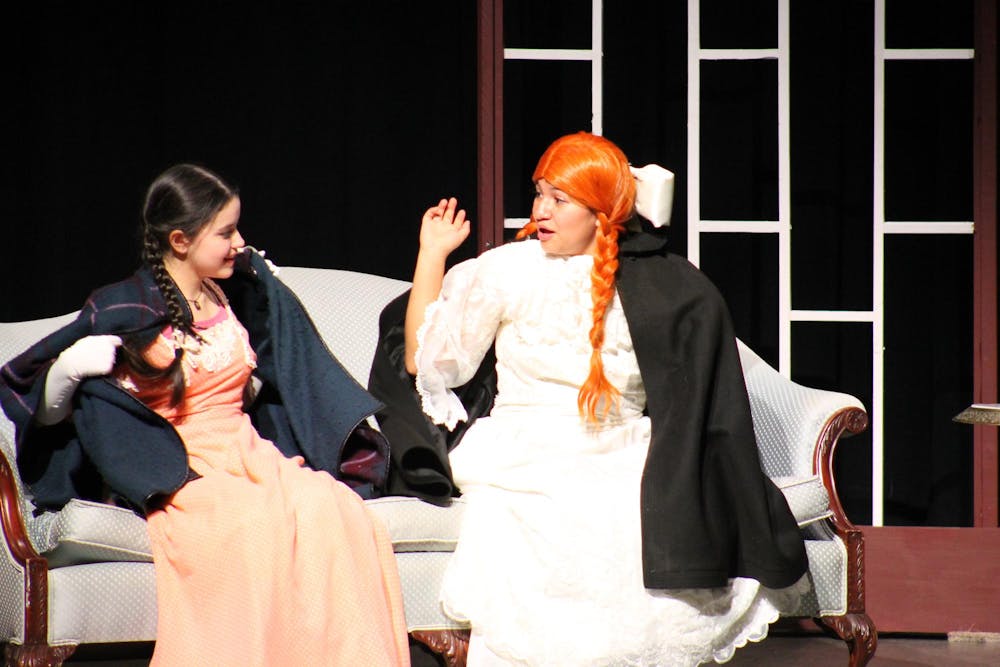
The Hart Community Performing Arts Association’s (HCPAA) summer 2025 production of "Anne of Green Gables" not only breathes life into this treasured story, but paints a vivid picture of Canada at the precipice of the 20th century, filled with delightful characters and pastoral vistas, a result only possible through the dedicated work of the cast and crew.
Anne Shirley is played by 14-year-old Izabela Hernandez, who rose to the challenge of leading the production with the enthusiasm and quick wit one would expect from her character. Her voice carried throughout the auditorium with resounding clarity, and her timing and physical comedy delivered the charm necessary for the role.
Olivia DeBrot and Jesse Bowman appear as Marilla and Matthew Cuthbert, respectively. Olivia captured Marilla’s development from a cold stranger to the stern, but ultimately loving, maternal figure for Anne. Her subtle acting choices highlighted the most emotional moments of the play. Jesse Bowman’s Matthew is shy but affectionate, offering encouragement and wisdom with a dry humor. Despite having fewer weeks to rehearse than the rest of the crew, nothing in Jesse’s performance would leave the audience wanting.
Clarisse Perigard played Diana Barry on Friday and Sunday’s performance, and her soft-spoken and sweet nature is a delightful contrast to Anne, but Clarisse’s most standout moment comes during the iconic raspberry cordial scene, leaving the audience howling with laughter. Gilbert Blythe is the most eligible bachelor of Avonlea’s schoolhouse, and Carson Jensen certainly got the message, delivering a charming performance that makes the audience sympathize with Anne’s begrudging annoyance. Ronda Bowman’s Rachel Lynde - the nosy and hypocritical neighbor to Green Gables - was a clear fan favorite who stole each of her scenes and wrung humor out of every joke she could.
Anne of Green Gables is a beloved classic known throughout the world, but one deeply entrenched in the culture and environment of its setting, Prince Edward Island (P.E.I.). In many fans' opinions, the most successful adaptations are ones that treat P.E.I. and the fictional town of Avonlea as characters in their own right. HCPAA delivered this in spades.
Each citizen of Avonlea, no matter how small their role, was rounded into a believable person rather than a stock character, and this was by no means accidental. The play's director, Maggie Bowman, and assistant director, Grace McGhan, encouraged the actors, especially the ensemble, to come up with backstories, names and families. It’s one of the basics of theatre performance that Maggie particularly wanted to focus on during rehearsals, especially as “it's something that I think we’ve lost, not having a summer youth theatre program like we used to back in the day…the kids don’t grow up knowing all the acting basics, and one of them is building your character.”
Another tried and true method of directing a successful production, especially one with so many iconic adaptations, is to go back to the source material, advice Maggie has cherished from her time as a young actress under Tom Kirk’s direction. Even her own run as Anne Shirley in 2011 did little to cloud her approach to directing. “[Kirk] was always like, ‘Go to the source material. Don’t watch the movies, don’t watch the TV show.’ So, of course, I’ve seen those things, but I didn’t re-watch them for this production. I did, however, re-read the book, and that’s something that’s been really fun…”
Revisiting the books offered some new perspectives, especially when it came to characters who, for the sake of run-time for a stage production, are given less material to work with. Even major characters, such as Marilla Cuthbert, revealed new angles for the actors to explore. As Maggie explains, “Marilla, at one point, was engaged to Gilbert Blythe’s father, and they broke it off. And the book doesn’t say why, but I was like ‘Marilla should have a reason, [the actress] should invent that.’”
This information led Olivia DeBrot to decide, “I don’t think I [Marilla] would like Gilbert… I think I am annoyed by his presence the entire play,” a direction that Maggie encouraged her to bring to the stage.
The production was marked with incredible attention to detail. The costume department was headed by Hannah Johnson, whom Maggie describes as an expert in historical fashion and costuming, and it shows. Despite their limited wardrobe selection, each silhouette is believably Edwardian through the use of small alterations and accessorizing, from the lace-up boots to the “puff” sleeves.
Maggie credited the help of volunteer Justin Nelson, who grew up in Nova Scotia, when it came to contextualizing the setting of P.E.I. “It was very helpful to get some of his different tips on those sorts of things. Things you never think about, but then suddenly stand out in the script.” Her example is a scene where Diana enters while discussing the potato crop going out on shipping vessels. “You [realize], yes, of course, that's how they got to market. But that also meant it was really difficult for [P.E.I.] to sell their crops on the mainland because they were reliant on the fishing boats and shipping trade, and that’s a little bit more sketchy than going by road.”
Another fun detail came from Marilla’s consistent use of the phrase, “Oh, go on with ya,” which is classic P.E.I. slang.
Perhaps one of the best examples of the production embracing the setting of P.E.I. was the use of music, from recorded tracks used to fill the silence between scene changes to hymns sung by the cast. For the latter, some of the hymns were suggestions by the script, but Maggie decided to take the musical choices a step further. “When I was getting a vision and theme for the show, I just decided to go in a musical direction because that’s what I really love.”
She explains researching the sort of music that would have been typical for the setting, the origins of the music and the shift in popularity of certain genres. “When you think about Prince Edward Island, in the 1890s it’s mostly going to be second generation immigrants from France, from Scotland and Ireland, primarily… When we think of folk music here in America, we think of Appalachian music, right? We think of Bluegrass… and that’s not Canada. I pulled a lot of inspiration from the Watersons from the UK, which was a Scottish group that collected folk tunes and made them really popular in the 60s and 70s.”
The keen listener would also recognize the shift from UK folk music to choral and harpsichord selections, denoting the introduction of recordings played on gramophones. Songs sung by the cast exemplified how music was approached back in a time when not everyone could read sheet music or reference recordings of popular hymns. Maggie explains how a lead singer in Amazing Grace “lines out the verse before [the congregation] sings it. Or during Country Life, everyone learned the chorus, and then you had soloists that would pick up the individual verses."
The result of these efforts, where almost every song is one that would reasonably be heard in Edwardian-era P.E.I., helps Avonlea feel authentic and material, a real place where the characters of Anne’s story are right at home.
Maggie, of course, cannot take all the credit herself, especially with a crew of 15 other volunteers. She has recently been offered the job as Hart High School Drama Club director, but was up front about her trepidations, as her work as a midwife-in-training requires her to be on call 24/7.
“I have a ton of experience. I really love this program. I’m familiar with it. But if it has to be me sitting in a seat at 3:30 every day, it’s probably not going to work out. But if you’re willing to let me build a team of people… then I think this could work really well. I have grown up here. I have a lot of contacts, (and) a lot of people that I know that are really competent at different things.”
Maggie commends the previous directors of the program, but is grateful for the help and to bring fresh perspectives from her vast crew. This is, perhaps, why this production of "Anne of Green Gables" feels so well-rounded, from the dedicated work of the cast bringing life to their characters through the advice and expertise brought by a vast crew.