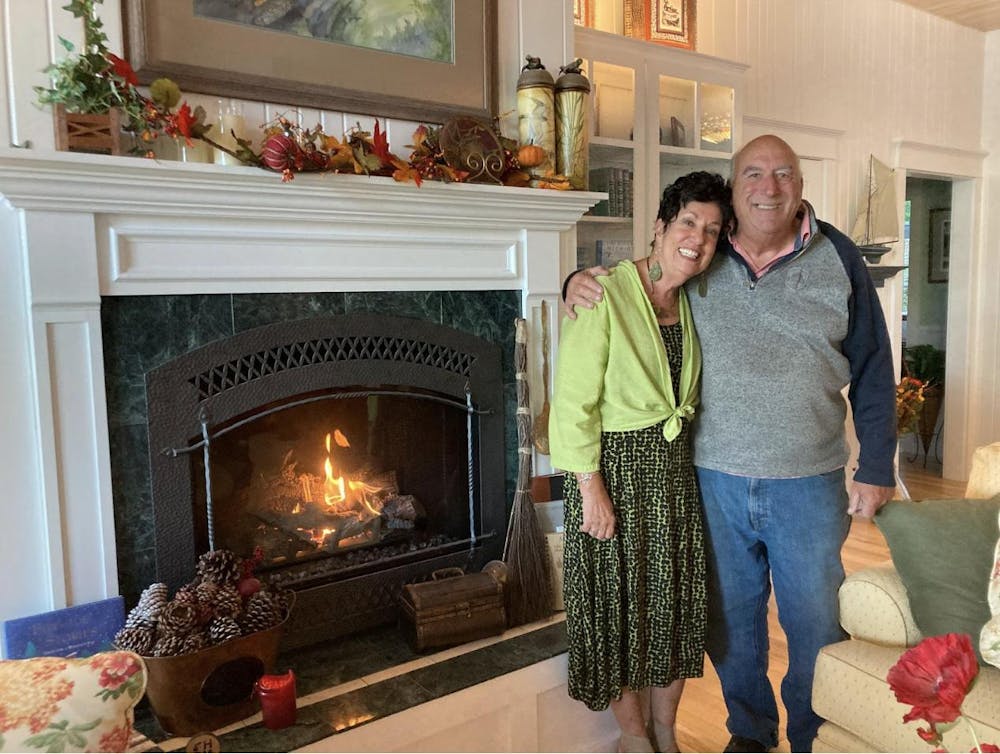
October is National Sudden Cardiac Arrest Awareness Month, and the Oceana Echo invites our readers to enjoy a two-part informative series highlighting the stories of two Oceana County residents whose lives were saved by the heroic efforts of family and friends following their own cardiac events this summer. We, along with their family and friends, are so thankful they are still with us. May their stories inspire, challenge and bring hope to all.
Two days before Mother’s Day this year, Barbara and Tom Sims, of Hart, were spending the night at home celebrating their 15th wedding anniversary. They enjoyed preparing a special surf and turf meal, complete with champagne, and were enjoying it together in their library when Barb told Tom she’d take care of the dishes and asked him to pick out a movie.
Suddenly the evening took a very different turn, as Barbara explained, “Tom was perfectly fine. We’d just finished our dinner and were enjoying looking at our wedding book. Normally I would have started putting things away in the kitchen, but then I told myself, ‘No, it’s my anniversary too - this can wait.’ I went to join Tom in the library, and he was completely unconscious. He didn’t have a pulse and was not breathing. His eyes were open, but I thought I’d lost him. Immediately I thought to check his mouth to see if he’d choked on some food and he bit my finger. I knew he was still in there and immediately called 911.”
She stopped to share that she often can’t find her phone, and if she can, it isn’t always charged. Miraculously, it was right on their coffee table.
Barbara continued, “I called 911 and had them on speakerphone, but I hung up, saying I was certified in CPR (cardiopulmonary resuscitation) and to please hurry. In hindsight, I wished I would have stayed on the phone with 911. Tom was slumped down on our loveseat, and I couldn’t move him. I started doing compressions, but the chair was too soft. I grabbed our wedding book and put it behind a pillow he had behind his back and started again.”
Those who have taken CPR training in the distant past may remember it was recommended to give 15 compressions, followed by two breaths, until help arrived. Recent studies have shown that it is just as effective to perform chest compressions only. Current training teaches participants to do chest compressions to the beat of the Bee Gees song “Stayin’ Alive.” That’s how fast someone needs to do CPR compressions for it to be the most effective. And that’s exactly what Barbara did.
“I could feel I was getting his ribs to move. They tell you in training you should press hard enough to make them go down. I worked at compressions for a good five minutes, and it was getting laborious. I kept calling Tom’s name and telling him, ‘I’m not losing you on our anniversary!’ Just before help arrived, Tom started to blink his eyes and move his head. I could hardly believe it. The CPR was working! Finally, after what seemed like forever, the EMTs and four members of the Hart Fire Department arrived. It was one of those nights where there were three other emergencies going on in the county at the same time. Even though Tom was conscious, the EMTs were insistent we needed to get him up and on the gurney because he would probably have another episode. And sure enough, two or three minutes later he flatlined. But this time he was hooked up. The firemen who had been on another emergency arrived next. Instead of shocking him, because compressions had worked for me, they started doing compressions again. I calmly, but firmly, told Tom, ‘No, you’re not leaving me!’ I talked to him the whole time. I was blowing on his face, telling him to stay with me. I was positive we could do this. I told the EMTs, ‘We’re not going to lose Tom.’ I was a woman on a mission!”
By then the neighborhood had gathered and wanted to know how they could help. Barb took charge once again and said she’d be fine. She promised she would keep everyone posted and followed the ambulance to Trinity Health Shelby Hospital.
“To be honest, I needed to be alone. I expected to see a corpse when I got to the hospital. I found out later Tom had flatlined a third time in the ambulance on the way to the hospital, but when I got out of my car at the hospital, I could hear Tom’s laugh and him telling the EMTs, ‘When I told Barb our dinner was to die for, I wasn’t serious.’
By this time the reality of what had just occurred started to sink in. Barb was afraid she’d done the compressions wrong and wondered if she should have done something differently. The EMTs and the staff at the hospital reassured her saying, “Look at him, he’s alive, you did everything right!”
After Tom was stabilized in Shelby, he was taken to Grand Rapids for further evaluation and a short hospital stay. “I had what is called ventricular tachycardia. Basically my heart raced, and then it stopped,” he said. “I asked both my EMTs and my doctor what the chances are that someone is brought back after something like this. The EMTs relayed that it is rare they get to talk to someone after such an event.”
Tom recalled that when he got to the hospital, Barb hadn’t arrived, and he was able to sign his own admission paperwork. “I talked with Mike (Barefoot) all the way to Grand Rapids, and he said in 15 years of running up and down the freeway with patients, that was the first time anyone had signed their own paperwork!”
Tom continued, “Thankfully I didn’t have any blockages. I had a pacemaker/defibrillator installed, and through the wonders of modern technology, it can start my heart again if needed. My heart is monitored 24/7. For Barb, the reason to do this story is the importance of knowing how to do this (CPR), but for me the thing I want people to know is what I learned about the difference between a cardiologist and a heart failure doctor. I now have both of them, but they are different doctors. They train and practice differently, they look at different studies, they treat patients differently and both are necessary in my situation.”
Today Tom is back home, and one would never know by looking at him that his heart had completely stopped numerous times back in May. Since performing these lifesaving maneuvers, Barb has shared with others, when given the opportunity, what happened and how important it is to be prepared.
“I’ve been taking CPR recertification courses since I was a young teacher. Doing the compressions felt exactly the way it did in training. I realized if I can do this, anybody can do this. We can’t depend on emergency help arriving right away. Have your phone near you….and charged. Better yet, have a landline. And most importantly, get the training yourself. You never know who you might need to help. I never expected to have to use it, but I’m so glad I was able to do it when the time came. I’m just so thankful for every day together since then.”
The Sims wish to thank all of the emergency responders who came to their rescue that day in May, from Life EMS Mike Barefoot and Dan Medema and from the Hart Fire Department Mark Haynor, Lynn Schiller, Kyle Dillingham and Dan Liembeck.