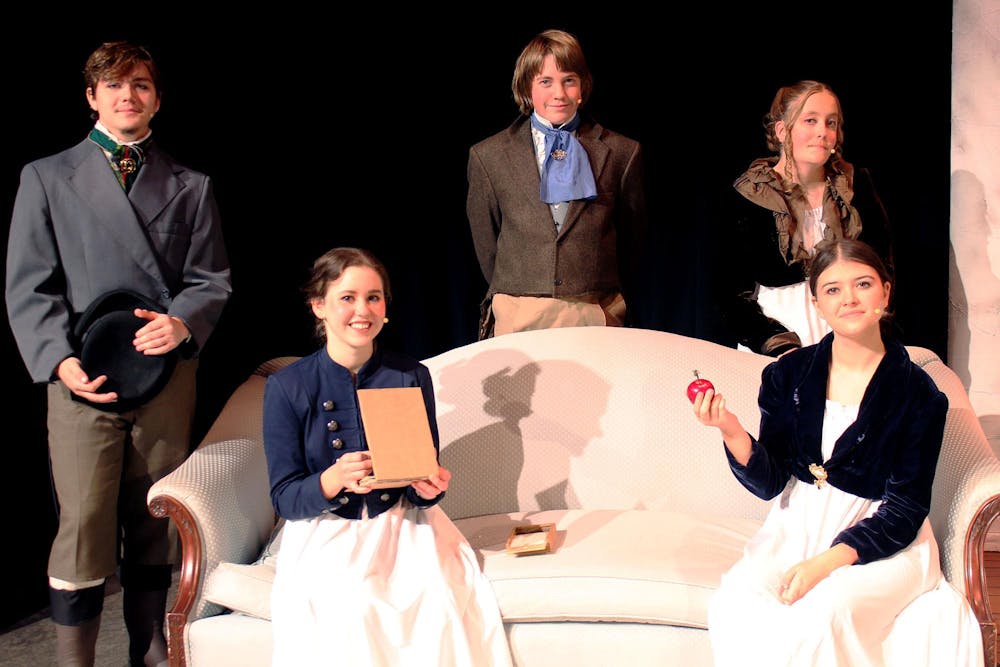
For Thanksgiving week, everyone can breathe a sigh of relief as I am finished with my series on the Armistice Day Storm. In fact, to add some levity to The 1306, I’d like to recall my viewing of the Hart Drama Club’s performance of Jane Austen’s "Emma" from earlier this month, sing the praises of the students, and gush for a moment about a period in history and an author that I absolutely love.
To contextualize the novel, "Emma" was published in 1816 by Jane Austen, although in the first edition of the novel she was merely known namelessly and as the female author of the previous works "Sense and Sensibility" and "Pride and Prejudice." It was the last of Austen’s novels to be published while she was still alive and starred, as she described, “a heroine whom no one but myself will much like.”
Which is unfair. I like Emma Woodhouse, “handsome, clever and rich.” I appreciate the flawed heroine and her character development. Unlike many other Austen heroines, Emma is too rich to be concerned about her inheritance and therefore is unconcerned about marriage. In fact, she’s quite content to never get married, live with her hypochondriac father in her childhood manor and meddle in the affairs of her fellow townsfolk.
Emma takes a particular interest in a Miss Harriet Smith, the “natural” (illegitimate) child of an unknown man, whom she is convinced is truly the daughter of some landed gentry. Our heroine proceeds to discourage a mutual love match for Harriet, encourages her unrequited affections for a pompous young vicar, and, overall, becomes too involved with her fantasy of Harriet to see the reality of her situation. All the while, the only censure Emma is given is from her love interest, Mr. Knightly, the brother of her sister’s husband (don’t think too much about it), who is 16 years her senior (don’t think too much about that either).
The novel is set in the fictional town of Highbury and is another of Austen’s entries into her preferred genre: a Comedy of Manners. The genre has a longstanding tradition in Western literature but saw a particular flourishing during the Regency and Victorian Eras of Britain. The main indicator of the genre is realistic satire about the manners of genteel society. Basically it can be boiled down to one-star reviews of Austen’s work “Ugh, if only people would sit down and have a conversation about their feelings,” and “Ugh, it's just a book about a bunch of people going to other people’s houses.”
All this to say, the genre is supposed to poke fun at how the buttoned-up societal expectations for the upper class at this time result in a slew of misunderstandings and pent-up longing. And I eat it up every time.
Many of these conventions of the genre, and how they informed the historical context of the Regency period, were carefully explored by the performers. As told by director Maggie Bowman, her students wanted to do a “serious play” for the autumn, wanting to expand beyond musicals and family-friendly shows. "Emma" was the perfect fit to scratch that itch without throwing the kids too quickly into the deep end. "It has that nice, historical feel, and it’s a comedy. But there’s really dense language, and it definitely pushed the kids,” she said.
A lot of hard work went into the costume and set design to portray a time and place, and Maggie shared some details she was particularly proud of. For the upper class, classical music like Bach and Mozart - including one piece played live by a student — was juxtaposed with traditional reels favored by the lower classes.
Many costumes were made from scratch by the costuming department, headed by fashion historian Hannah Johnson. The main female cast sported white, empire-waist gowns reminiscent of Greek sculptures - a major source of aesthetic influence for the era - accessorized with trimmings, jackets and bonnets to allow some variety and also show the passage of time throughout the play.
In order to understand the play, the kids had to understand Regency culture, such as the lack of questioning Emma and Knightly’s age-gap (again, don’t think too much about it), and why Emma was so hopeful that Harriet was actually a gentleman’s daughter, as that would make their friendship one of equals.
The students also inadvertently learned another lesson of theater: how to adapt. As Maggie pointed out, of the 12 cast members, seven did not perform in their original roles, rather taking over from someone else who had to leave or switch roles due to unforeseen circumstances.
Izabela Hernandez played Frank Churchill in the show, despite originally being cast as Miss Bates, who “was just really this energetic personality,” in comparison to Frank who is, “more relaxed on some level. He’s also really full of himself, and Miss Bates thinks of everyone before herself.”
Melody Kasza inherited the role of Miss Bates from Izabela, whom she really related to as a character. Zoey Fillips’ change from Mrs. Weston to Harriet Smith was major, going from a character with few lines to one of the most integral characters in the story. For Caylin Hill as Jane Fairfax, this was her first speaking role in a show ever. Calvin Helms stayed as Mr. Elton through rehearsals, much to his relief.
Another detail Maggie shared was the adaptation from novel to play, complimenting the show’s playwright on the wonderful job in lifting many direct Jane Austen quotes. “It’s a lot of dense language… so we did have to spend a lot of time digging into like, what are you actually meaning when you say this? What story are you trying to tell?”
Despite only having eight weeks to not only learn but also understand the lines, the students did a wonderful job conveying the wit and charm that makes Austen’s works so timeless and enjoyable, and I sincerely hope they’re all proud of their successful venture into “serious” plays.