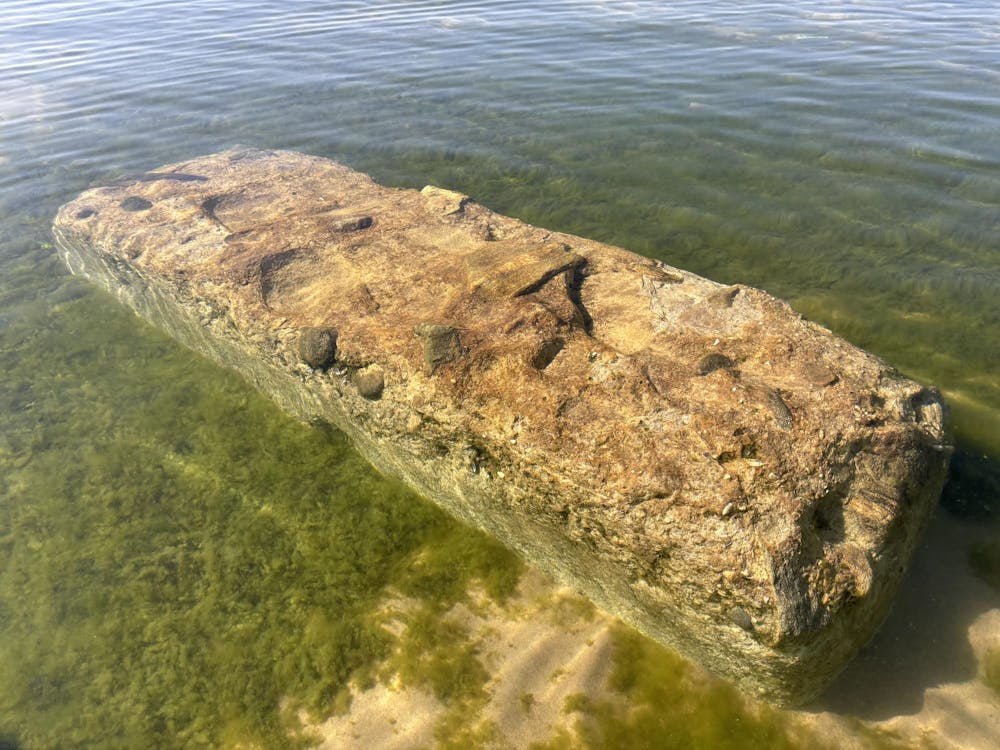
The piers that existed at Sammon’s Landing during the 1880s and 1890s transported both goods and travelers, however, their main purpose was to support the fruit-growing industry of Little Point Sable. While tourists were a welcome addition, the shoreline at that time was solely focused on cultivating fruit trees, which is a notable distinction from the summer cottages and resorts that now make up Silver Lake. Even Charles Mears’ and E.A. Congdon’s visions of bustling lakeside resorts remained visions, never coming to fruition during their time in Oceana County.
It was a Chicago lawyer who shepherded Silver Lake into the vacation oasis we see today, and longtime readers of the column might recognize his name: John H. Hill. Hill was most notable in his hometown of Chicago for being a staunch prohibitionist. A participating member in several organizations and associations dedicated to booting liquor out of the city, Hill even ran as mayor of Chicago in 1915 on a crowded ballot as the pick of the Prohibition Party. Considering the city Chicago is, Hill lost with only 3,590 votes to his name.
But before all that, in 1897, Hill began purchasing Lake Michigan property - first in Benona Township, then in Golden - sight unseen. His first recorded trip to Michigan was in 1900, and by 1902 he had 1,700 acres in his real-estate portfolio.
Staunchly religious and deeply dedicated to the prohibitionist cause, Hill had a very clear vision for his property - a summer resort and religious educational retreat, inspired by communities such as Epworth Heights north of Ludington and the renowned Chautauqua in Upstate New York. For Hill, Little Point Sable was his own little paradise, dedicated to educating and upholding the causes he held dear.
Hill’s first advertisement of his property was in August 1903 in the Chicago Tribune: “Little Point Sable. The most western point of southern Michigan… between White Lake and Pentwater. It is an ideal summer place: broad beach, wooded shore, high bluffs, good soil, nice breeze, splendid fruit district.”
Thank goodness he visited the property before advertising it, otherwise, how else could he have included such specific details? Hill goes on to price his “large lots for summer houses or fruit places, fronting and overlooking the lake” at $100. Also included in the ad was the note that the properties are serviced by three Goodrich steamer lines to and from Chicago, which, of course, stopped at the Peach Ridge Pier.
Hill’s next advertisement, taken out a few weeks later, offered the “Old Orchard Lodge” and cottages to rent at $6 per week (“a delightful place for an outing!"). In September, Hill added round-trip boat fare to the listing at $2.50, all bases covered now. This same year, the Peach Ridge Pier was extended to accommodate the Steamship Frontenac, which ran between Chicago and Frankfort to the north.
Hill’s 1907 advertisement is the most inclusive, listing attributes such as “plenty of big fish - bass, trout, pickerel," with “Tent services on Sunday,” a “high-class community already established” and - most importantly - “no hay fever.”
In 1904 and 1907, respectively, the North and South Plats of summer cottage subdivisions were created, with over a hundred small lots for cottages. In 1927, this community of cottages would separate from Hill and become the Little Point Sable Association. As introduced in the column last year, the Boynton Cottage at the Oceana County Historical & Genealogical Society’s Museum Complex is an example of what those rustic cottages would have looked like. In the meantime, Hill’s Midwest Chautauqua had become a success, with an onslaught of Chicago families renting lodgings, purchasing properties and attending lectures and sermons at the Old Orchard Lodge or the tent “Tabernacle.”
The Peach Ridge Pier was used by Hill’s vacationers throughout the 1900s and early 1910s, serviced by several boats and steamships, some of which were bought by Hill himself. But in 1912, Hill introduced the “auto-bus” as a new mode of transportation, shuttling guests in from the Shelby train station.
Hill’s Old Orchard Lodge continued to operate until 1941, with Hill passing away in 1944. The Little Point Sable Association continues to this day.
As for the fate of the pier, I think it can best be summarized by my collaborator for this topic, Mark Thomas. Mark is a former civil engineer and current resident of the Beachcombers Subdivision on Little Point Sable - land that once used to belong to Hill, in fact.
As Mark put it, “Although remnants would have remained in the water for many years, like all the wooden piers once prevalent along the eastern shore of Lake Michigan, nature’s wrath of ice and waves will ultimately win the battle. However, in the summer of 2025, I found two concrete & stone foundations in the water at the correct location of the old pier - solid proof of what was once there so long ago. It's hard to imagine this always-quiet stretch of beach was once the hub of activity for bustling communities, very important to the local economy and ‘development’ of the area. But it surely was.”