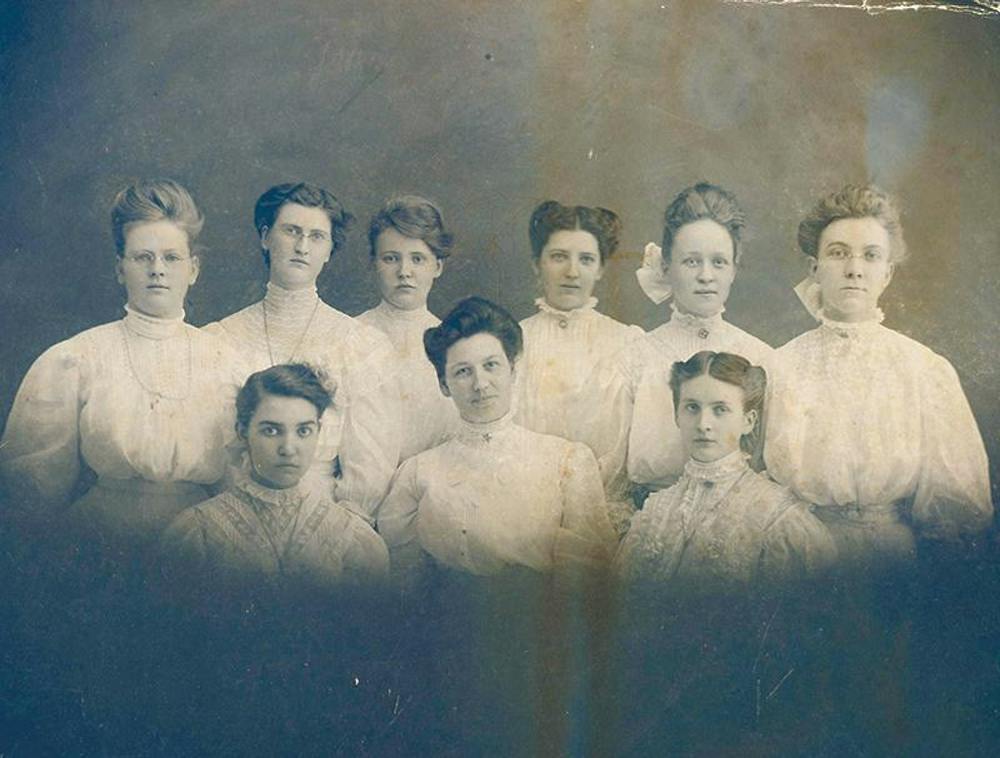
A place I’ve often come across in researching the everyday people of this area is the “County Normal School.” More often than not, it's noted as the alma mater of many a young woman from the early 20th century who ended up teaching - whether briefly or as a lifelong career - at one of the many local rural schools. For the most part, context clues make the purpose of County Normal School clear: it was where teachers learned to teach.
As Walt Urick at the Oceana County Historical & Genealogical Society (OCH&GS) put it, "They took some of the brightest kids from the county and funneled them into County Normal. Then when they graduated, they’d teach in the schoolhouses.”
Further, accounts of local teachers on file at the OCH&GS verify this assembly line: rural student to bright-eyed graduate, then back to the one-room schoolhouses to teach the next generation.
County Normal was a one-year, intensive program that provided a provisional teaching certificate to graduates, typically for a year of work in a rural school teaching kindergarten through eighth grade. This program was overseen by Michigan’s Department of Education, and they even issued the diploma at matriculation. County Normal operated out of the old Hart High School (a multi-story, brick building), reserving two dedicated classrooms on the top floor. Classes consisted of instruction on current grade-school curriculum, classroom management and teaching techniques - not unlike nowadays. In that same vein, County Normal also provided student teaching, which was observed by a “critic teacher” for correction and providing backup. This symbiotic relationship allowed the County Normal students to work with local children and provided grade-schoolers with bonafide school instruction.
Normal schools were a not uncommon concept throughout the Americas and Europe, dating back to 17th-century France as model classrooms where prospective instructors could practice. It's unclear when Oceana’s County Normal began, as the OCH&GS’s oldest documented photo of a Normal graduating class dates to 1905. There is a photograph of an instructory school class from the 1890s, but it was not definitely labeled as a “Normal” school. It’s possible this earlier school was later subsumed into or became the County Normal School at the turn of the century.
Often, the Hartian yearbook had a page or two dedicated to County Normal, and many Normal students took it upon themselves to handmake their own dedicated yearbooks filled with snapshots of students, thanks to their instructors, their class songs and flowers, not to mention lists of inside jokes that came about after their year of comradery. It also becomes clear the place County Normal had in the community - not only had the students grown up in Oceana and taught county grade-schoolers, but they were frequent chaperones at school dances and volunteers at carnivals and potlucks. If there was a county event, especially in the 1900s and 1910s, best believe a County Normal teacher-in-training would be there helping serve punch.
Most students who attended Normal did so out of financial necessity. They wanted to become teachers, but did not have the funds to move out of the area and attend a proper college. Oceana County residents could attend County Normal free of charge, and, as noted in the Oceana County History book (Vol. I), “it was assumed the new teachers would seek employment in the county rural school.” Such is the case as found in teachers’ accounts, some even finding employment in the one-room schoolhouses they themselves attended.
Teaching in rural schools was no walk in the park, however. Not only did these County Normal graduates face impoverished students and inconsistent attendance, but they themselves had to coordinate housing and their commutes to work, often lodging with local families. This is part of the reason why I’ve found so many postcards from young local teachers sent to their local families. Sure, Mom and Dad may live 30 miles down the road, but that might as well be 100 miles for a busy 20-year-old without an automobile.
Some teachers worked for a handful of years before marrying or finding alternative work, but just as many dedicated their lives to their careers, renewing their certificates at either Normal or through classes at any accredited college or university.
County Normal closed in 1943, with a final graduating class of 15 new rural teachers. The Oceana County History book also notes that it wasn’t a decision made due to a lack of need, “The loss of Oceana County Normal produced a hardship on the county schools. No longer did they have a source of new teachers to fill the vacancies left by retirement, marriages or deaths.”
For decades, Oceana County farmed its distinguished youth to teach their own, with bright rural students giving back to the community that raised them. As Oceana County History concludes, County Normal, “served the county well in its many years of existence.”