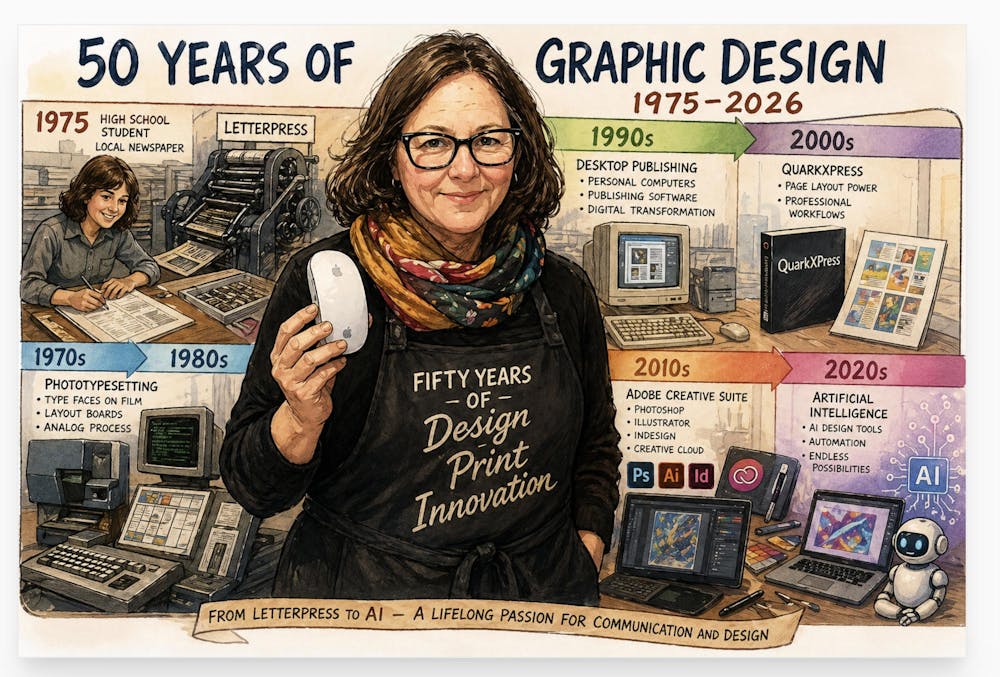
Fifty years is well known as a golden anniversary across many aspects of life, and for Mary Lulich, owner of Pixel Grafix in Hart, she has reached that incredible milestone in the print industry. While Lulich will close her storefront operation in Hart on May 31, she plans to continue the business from home, doing what she loves, in and for the community.
Many are familiar with Pixel. Many have used it but do not know the history behind Lulich, who has given it so much.
The year was 1975, and at 15 years of age, Lulich looked like any other teen, going to school and using her spare time to pursue her hobbies.
“I was buying cards at the Hallmark store in downtown Shelby and turning them into my own art projects,” she remembered. “I was looking for a way to get the cards cheaper, so one day I went into the Oceana Herald office and asked Maxine (Huggard) if she could use any help. I wanted to be able to get the greeting cards cheaper. She told me she didn’t need help downstairs but they might need help upstairs.”
Lulich remembers taking the 21 wooden steps of the historic building to the second floor, where she got her first job.
Lulich explained how she started out at first as the Huggards’ "go-fer," but shortly after watching Oceana Herald employees Dick and Sally Schultz typeset on one of the first computers in Shelby, she was hooked.
“Coincidentally, my first day on the job was the last day they used molten lead in the 1886 vintage linotype typesetter,” Lulich reminisced. “I wasn’t born into it (newspaper typesetting), but I loved every part of it. In middle school I wanted to take shop class, but back then girls couldn’t take shop. Looking back, the education I got from the ‘craft masters’ at the Oceana Herald was a gift.”
Lulich would go on to hold a co-op job at the newspaper office every school day from 2-5 p.m. and then during the summers throughout high school.
“Sally was basically coding - nobody called it that at the time - but I stood behind her watching and learning,” Lulich said. “I did sell some advertising for the paper, but I did mostly typesetting.”
In 1980, Lulich went to college in Grand Rapids. “I was able to get decent-paying part-time jobs as a typesetter because I already knew how to use that equipment” for various small businesses, Lulich recalled. Her first full-time job was with Hayworth, where she worked for two years in their publication department as a typesetter.
Following her time at Hayworth, Lulich took a job with the Detroit-based company CompuGraphics, where she traveled from Detroit to the East Coast teaching other businesses how to do phototypesetting. By the early 1990s, Lulich had grown tired of the travel, and took a job in the publications department at the FTD headquarters in Southfield, Michigan. By the mid-90s, CompuGraphics was phasing out, and desktop publishing was becoming the next great thing.
With all this experience under her belt, from 1995-2012, Lulich and her former husband decided to open their own business in Detroit called GrafixJam, mainly working with tier-one suppliers in the auto industry.
In 2012, Lulich moved back home to Shelby, where she worked for Oceana Graphics on East Main Street in Hart. Then in 2015, she opened Pixel Grafix in downtown Shelby, providing a variety of design and print services. In 2020, Lulich decided to move her Pixel Grafix business to Hart, where she has operated out of a business suite, on the north side of the Hegg’s Furniture store.
Starting June 1, Lulich will make yet another move, to her home office, where she plans to continue running Pixel Grafix, providing design services for the community she loves.
“The past 11 years have been all-consuming,” she said. “Post-Covid, I’ve seen a 25-30 percent loss in business as people learned how to order everything online,” she said.
Despite today’s digital world competition, Lulich still considers herself a crafter first. Even though AI (artificial intelligence) is becoming the way we do a lot of things, she admits she didn’t embrace the technology at first. “Last October I was really fighting it. I told myself I wasn’t going to use it and decided to retire.”
But then she added, “AI bit me hard. Because it ‘knows me,’ it creates better art without mechanics, freeing me up to be and do other things (incidentally, with the help of AI, Lulich created the “image” that accompanies this article). In 50 years I’ve gone from metal to AI. I’ve loved every minute of my craft. It’s not felt like work.”
Over the years, Lulich has been able to mentor many good employees and says the biggest plus of owning a local business has been making so many friends in the community where she grew up.
Lulich said she is not closing her Pixel business, only the storefront. She still plans to offer online graphic design and print services to customers who want it. However, she is looking forward to working from home and not having to worry about operating a storefront business. She also hopes to find time to pick up some of her artistic hobbies that have been put on hold all these years.
Lulich is looking forward to being able to continue providing her customers with the service they need, just in a different location. “I have no regrets. I’ve loved my life and am so grateful to the community for their support,” Lulich said.